


The Insurance of the Throne

Collaborative Article By Sanhedrin Advisors Mr. Shawn Lee and Rabbi Yosef Edery
Why God’s Kingship Is Freedom, and Why the Messiah Must Be a Servant
The Torah never lets us forget where true sovereignty was born.
Over thirty times, the living God anchors His authority not in the power to crush, but in the act of liberation.
Again and again, the same phrase thunders across the Law:
“I am the LORD thy God, who brought thee out of the land of Egypt, out of the house of bondage.”
— Exodus 20:2; Deuteronomy 5:6
“I am the LORD your God, which brought you out of the land of Egypt.”
— Leviticus 19:36
“I am the LORD your God, which brought you forth out of the land of Egypt, to give you the land of Canaan, and to be your God.”
— Leviticus 25:38
“For unto Me the children of Israel are servants; they are My servants whom I brought forth out of the land of Egypt: I am the LORD your God.”
— Leviticus 25:55
“I am the LORD your God, which brought you forth out of the land of Egypt, that ye should not be their bondmen; and I have broken the bands of your yoke, and made you go upright.”
— Leviticus 26:13
“I am the LORD your God, which brought you out of the land of Egypt, to be your God: I am the LORD your God.”
— Numbers 15:41
“Beware lest thou forget the LORD, which brought thee forth out of the land of Egypt, from the house of bondage.”
— Deuteronomy 6:12
“Lest thine heart be lifted up, and thou forget the LORD thy God, which brought thee forth out of the land of Egypt, from the house of bondage.”
— Deuteronomy 8:14
“That prophet or dreamer shall be put to death, because he hath spoken to turn you away from the LORD your God, which brought you out of the land of Egypt, and redeemed you out of the house of bondage.”
— Deuteronomy 13:6
“And thou shalt stone him with stones, that he die; because he hath sought to thrust thee away from the LORD thy God, which brought thee out of the land of Egypt, from the house of bondage.”
— Deuteronomy 13:11
These verses are not decoration.
They are the constitution of a new kind of kingdom.
God’s crown is not an instrument of extraction but a rescue from the extraction machine.
Pharaoh was the “king of the nations” par excellence—the one who took sons, took labor, took dignity, and gave back bricks without straw. Against that, Hashem plants His own throne.
His kingship is not a domination system; it is an insurance policy against domination systems.
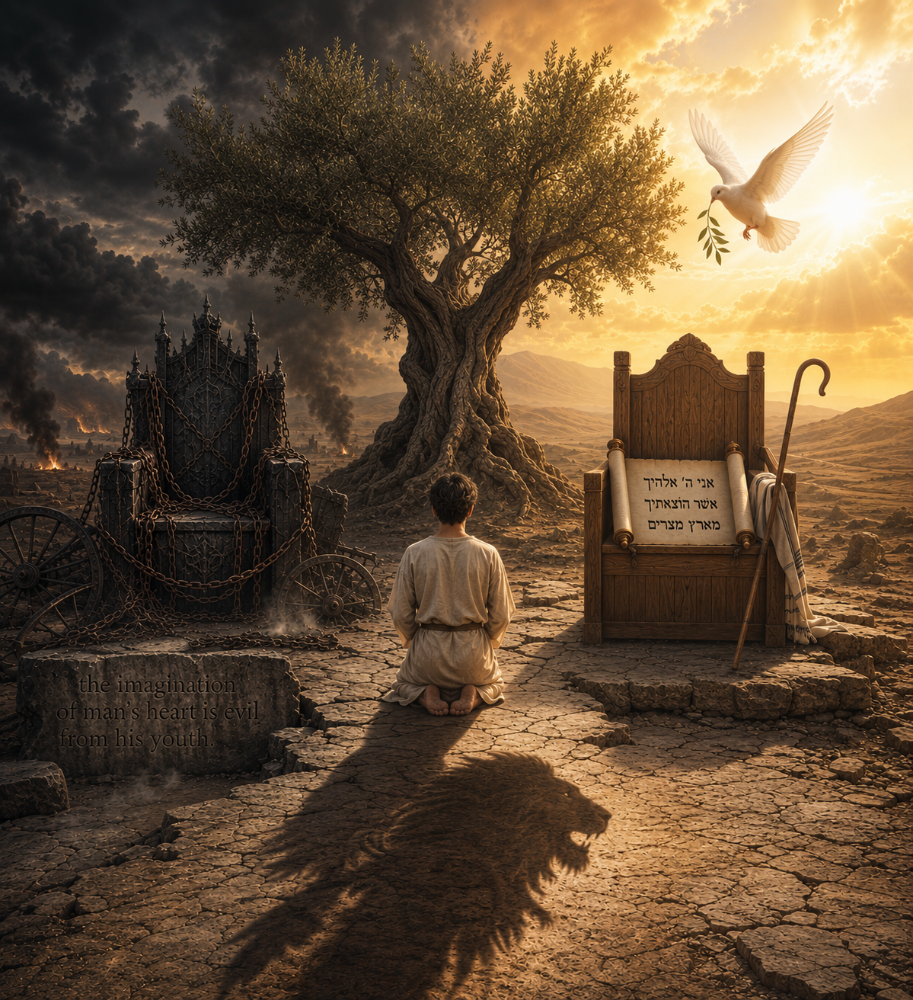
The Torah knew that human nature left to itself would rebuild Pharaoh’s palace in every generation. After the Flood, God diagnoses the permanent sickness:
“The imagination of man’s heart is evil from his youth.”
— Genesis 8:21
Given a crown, the human heart tends toward extraction. Therefore, God’s direct rule was a kindness—a bestowal of His kingdom upon a freed people so that no mortal could enslave them again. He is “King in Jeshurun” (Deuteronomy 33:5) not to burden them, but to ensure that the burden never returns.
The Torah’s original vision was a kingless theocracy, a “kingdom of priests” (Exodus 19:6), where the only Master was the One who had already proven He would break yokes, not forge them.
The Concession and Its Correction
Yet the people could not sustain that invisible trust.
They asked for a king “like all the nations” (Deuteronomy 17:14; 1 Samuel 8:5). God listened. He did not reject the request, but He legislated a severe discipline: no multiplying horses, wives, or gold, and a heart never lifted above the brethren (Deuteronomy 17:16-20).
Kingship entered the covenant as a concession—a gift wrapped in a warning.
God would give what the people asked, but He would fence the gift with law to prevent the rise of a new Pharaoh.
The messianic office is the rectification of that concession. A king must be present because the people asked for embodied sovereignty. Without a king, the final order would ignore human consent.
But the true Messiah must solve the Samuelic problem: a throne without predation, a crown without the tax machine.
The answer is not abolition; it is transformation. The Messiah is the king who fulfills Deuteronomy 17 perfectly—the brother-king, the servant-king, the one who reads the Torah and lives it.
The prophets saw this clearly.
Through Ezekiel, God promises:
“And I will set up one shepherd over them, and he shall feed them, even My servant David; he shall feed them, and he shall be their shepherd. And I the LORD will be their God, and My servant David a prince among them; I the LORD have spoken it.”
— Ezekiel 34:23-24
“David My servant shall be king over them… and My servant David shall be their prince forever.”
— Ezekiel 37:24-25
Why is David the eternal model?
Not because he was flawless, but because he understood that his throne existed only as a servant-of-Hashem role. His legitimacy was never in his own might; it was in his total reliance on the God who brought Israel out of Egypt.
The true Messiah, Son of David, will reign by the same surrender. His crown is not a rival to God’s; it is the visible proof that a human can rule without becoming Pharaoh. He is the electric car in a world of combustion engines—a completely different operating system for power.
The Shallow Politics of a Hundred Years
Today, the world exhausts itself with the cheap politics of ego and extraction. Leaders like Trump, Netanyahu, and bin Salman are not anomalies; they are the predictable output of kingdoms built on the imagination of man’s heart.
Modern nation-states—Israel (1948), Saudi Arabia (1932)—are barely a century old, creations of treaties and oil, not of a covenant rooted in millennia. They lack the ideological depth to generate a peace that lasts a thousand years. Their struggles are gas-driven: noisy, polluting, and forever competing.
The path forward lies not in more frantic nationalism but in returning to the root.
Judaism has held the blueprint for 3,000 years, since Abraham our father. Its truth is not exclusive in a tribal sense; it is the original call to all families of the earth (Genesis 12:3). The ancient Chinese spoke of Shangdi, the One Master, and the Mandate of Heaven—a ruler’s right to govern dependent on divine justice. Islam and Christianity are, at their core, branches of the same Abrahamic faith, longing for the same kingdom. What would Hashem have us do?
Unite not under a new Caesar, but under a humble, servant king who represents the God that freed slaves from Egypt.
This king would not be another ego combating other eagles. He would be the embodiment of the Torah’s kingship: restrained, righteous, never lifting his heart above his brothers. His reign would connect heaven and earth not by force but by freedom. The nations would flow to him not to be taxed, but to learn the ways of the Lord.
The throne of the Messiah is the ultimate insurance—not against foreign armies, but against the tyranny that rises from our own corrupted hearts. God’s original kingdom was a kindness to keep Pharaoh out.
The Messiah restores that kindness in human form, proving that a king can exist who will never make you cry out under the burden of the crown. He is the concession granted, the corruption restrained, and the liberation made permanent.
The world does not need a newer political machine.
It needs the ancient, quiet, and electric reign of the servant who sits on David’s throne forever—not as a master, but as the living proof that God has heard, and God has answered.
And that Hashem - the king of kings - is truly the master of the universe, which we stand humble before him - blessed be he.


Comments