


Matot–Masei-11 July 2026 / 26 Tamuz 5786

“Gaddi’s Notes on the Eternal Wisdom of the Prominent Sages”:
When Words Become Covenant and Journeys Become Torah
From Matot to Masei: How Does Israel Move From Wilderness to Destiny?
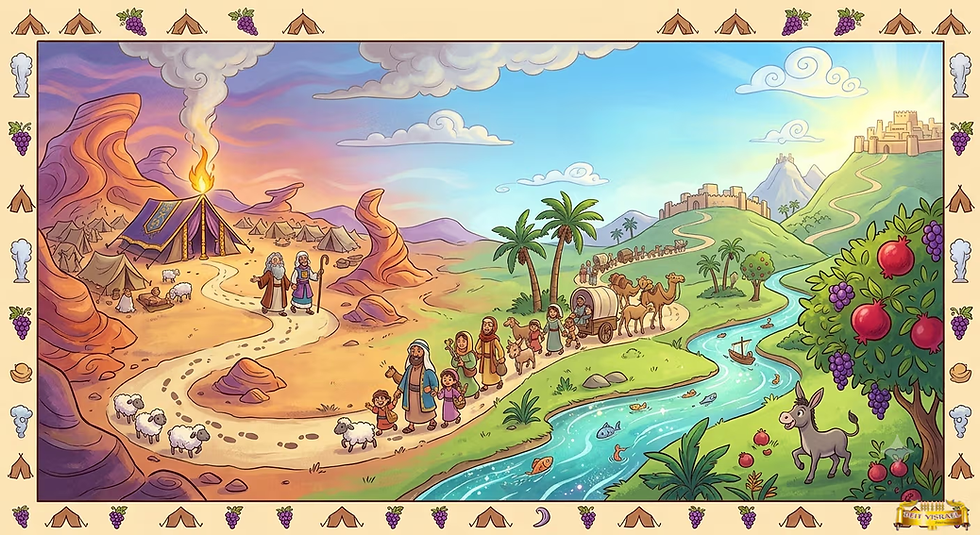
Parashat Matot–Masei: From Words to Journeys, From Exile to Inheritance
Matot–Masei closes the Book of Bamidbar/Numbers.
The sages see these portions as more than historical events.
They describe the spiritual journey of Israel: how speech must become holy, how war against impurity must be fought, how material blessing must be used responsibly, and how every journey of exile leads toward the promised inheritance.
🗣️ 1. Matot: The Holiness of Speech and the Power of Vows
Matot begins:
“When a man makes a vow to HaShem… he shall not break his word; according to all that comes out of his mouth, he shall do.”
Numbers 30:3
The sages teach that human speech is not small. Speech is the bridge between the inner soul and the outer world. When a person speaks a vow, he takes something ordinary and places it under spiritual responsibility.
The Talmud teaches that one who makes a vow must be extremely careful, because words create obligation. The mouth can build holiness, but it can also create spiritual danger if used carelessly.
Deep concept
The beginning of Matot teaches that before Israel can enter the Land, they must first sanctify their speech. The Land of Israel is not inherited only by physical strength. It is inherited by a people whose words are truthful, whose promises are holy, and whose mouths are aligned with HaShem.
“He shall not profane his word.”
The Hebrew idea is powerful: do not make your word ordinary or empty. A holy person is measured not only by prayer, but by whether his daily speech carries truth.
⚔️ 2. The War Against Midian: Fighting Spiritual Confusion
Matot continues with the war against Midian. Midian had caused Israel to fall through immorality and idolatry in the episode of Baal Peor.
The sages explain that Midian represents more than one nation. Midian represents division, corruption, and spiritual seduction. The Hebrew root of Midian is connected by many commentators with madon, meaning strife or quarrel.
Midian’s attack was not only military. It was spiritual. They tried to weaken Israel from within by mixing desire, idolatry, and confusion.
Deep concept
Before Israel enters the Land, they must remove the inner Midian: the force that divides the heart from HaShem.
The war against Midian teaches that Israel’s greatest danger is not always the enemy outside, but the corruption that enters the soul through compromise.
The sages often teach that holiness requires separation from destructive influences. This does not mean hatred of people. It means the soul must know what destroys its covenant.
💰 3. The Spoils of War: Elevating Material Blessing
After the war, the Torah describes the spoils and their division. This may seem like a technical matter, but the sages see deep order here.
The warriors receive a portion, the community receives a portion, and gifts are given to the Kohanim and Levi’im.
This teaches that material success must not remain selfish. Wealth gained through Divine help must be elevated through gratitude, justice, and sacred giving.
Deep concept
The Torah is teaching that victory belongs to HaShem. Therefore, even the spoils of war must pass through holiness.
A person may succeed in business, leadership, learning, or family life. But the question is: Does that success become service of HaShem, or does it become ego?
Matot teaches that blessing must be distributed with responsibility.
🏕️ 4. Reuben and Gad: The Danger of Choosing Comfort Before Mission
The tribes of Reuben and Gad ask to settle on the eastern side of the Jordan because they have much livestock and the land is good for grazing.
Moses rebukes them strongly at first, fearing that they are repeating the sin of the spies by discouraging the conquest of the Land.
They then promise:
“We will go armed before the children of Israel until we have brought them to their place.”
Numbers 32:17
Moses agrees, but only on condition that they fight together with the rest of Israel.
Deep concept
The sages point out that Reuben and Gad mention their cattle before their children. Moses corrects their priorities by speaking first of their children and then their animals.
This teaches a timeless lesson: when material concerns come before family, covenant, and mission, the soul becomes disordered.
Reuben and Gad are not rejected, but they are corrected. They can live outside the main borders, but they must not separate from the destiny of Israel.
Spiritual meaning
A person may live physically outside the center of holiness, but he must not live spiritually outside the mission of holiness.
The tribes beyond the Jordan teach the responsibility of all Israel: even if one’s personal inheritance is secure, one must still fight for the inheritance of the whole nation.
🛤️ 5. Masei: The Forty-Two Journeys of the Soul
Masei opens with the list of Israel’s journeys in the wilderness:
“These are the journeys of the children of Israel…”
Numbers 33:1
The Torah lists forty-two encampments. The sages and later mystical writings explain that these journeys are not only geography. They are the map of the soul.
Every station represents a stage in spiritual growth: leaving Egypt, facing hunger, confronting fear, failing, repenting, receiving guidance, and moving forward again.
Deep concept from the sages
The Baal Shem Tov taught that the forty-two journeys exist in every person’s life. From birth until the final return to the Creator, every person travels through spiritual stations.
Some places are sweet. Some are bitter. Some are places of failure. Some are places of revelation. But all are part of the journey toward the Divine purpose.
This is why the Torah records even the difficult places. The failures are not erased. They are transformed into teaching.
🧭 6. Why Does the Torah List the Journeys?
Rashi, quoting the Midrash, explains that HaShem listed the journeys to show His kindness. Although Israel wandered for forty years, they were not constantly moving. They had resting places.
This reveals Divine mercy. Even in exile, HaShem gives rest. Even in judgment, there is compassion.
Deep concept
When a person looks back at life, he may see confusion: “Why did I pass through this place? Why did I suffer that delay? Why did I fall there?”
Masei teaches that one day the journey will be read like Torah. The scattered places will become a sacred map.
What looked like wandering may become revelation.
🛡️ 7. Destroying Idolatry:
Preparing the Land for the Shechinah
“You shall destroy all their carved stones… and demolish all their high places.”
Numbers 33:52
The sages explain that the Land of Israel cannot tolerate idolatry because it is the dwelling place of the Shechinah.
Idolatry is not only bowing to statues. On a deeper level, idolatry is giving ultimate power to anything other than HaShem: money, ego, fear, pleasure, political power, or human pride.
Deep concept
Before Israel can inherit the Land, they must remove false worship. Before a person can become a vessel for holiness, he must remove the idols within the heart.
The Land represents the soul. The command to remove idolatry means: clear the inner land so that the Divine Presence can dwell there.
🗺️ 8. The Boundaries of the Land: Holiness Needs Structure
The Torah carefully describes the borders of the Land.
This teaches that holiness is not vague. Holiness requires boundaries.
The sages teach that boundaries protect sanctity. Shabbat has boundaries. Marriage has boundaries. Speech has boundaries. The Land has boundaries. The soul also needs boundaries.
Deep concept
A life without boundaries becomes spiritual confusion. But boundaries given by Torah create peace, identity, and purpose.
Masei teaches that inheritance is not only receiving land. It is receiving a defined mission from HaShem.
🏛️ 9. Cities of Refuge: Justice With Mercy
The Torah gives laws of arei miklat, cities of refuge, for accidental killers.
These cities protect the person who killed unintentionally from revenge until proper judgment is given.
Deep concept
The cities of refuge reveal the balance of Torah justice:
Sin is serious, but repentance is possible.
Bloodshed is terrible, but intention matters.
Justice must be firm, but mercy must guide it.
The sages explain that the roads to the cities of refuge had to be clear and marked. Spiritually, this teaches that the path to repentance must also be clear. A community must not only punish wrongdoing; it must also create pathways for return.
📖 10. Matot–Masei as the Closing of Bamidbar
The Book of Numbers begins with Israel arranged in camps around the Mishkan. It ends with Israel standing near the border of the Land.
This is the movement of the whole book:
From wilderness to inheritance.
From complaint to responsibility.
From wandering to mission.
From disorder to holy boundaries.
From speech to action.
From exile to entry.
Matot teaches: sanctify your words.
Masei teaches: sanctify your journey.
Together they teach that the people of HaShem must enter the Land with truthful speech, purified hearts, unity, courage, and
responsibility.
✨ 11. Messianic Depth: Every Journey Leads Toward Redemption
The sages see Israel’s wilderness journey as a pattern for all exile. Just as Israel traveled through forty-two stations before reaching the Land, so too the Jewish people and the scattered souls of Israel pass through many exiles before final redemption.
Every exile has a purpose. Every test refines the soul. Every movement prepares the final return.
The final message of Bamidbar is not despair. It is preparation.
The Torah does not end the book with Israel lost in the desert. It ends with Israel facing the Land, ready to cross over.
Final spiritual message
Matot–Masei teaches that redemption requires four preparations:
Holy speech — keeping vows and guarding the mouth.
Holy battle — removing Midian, confusion, and inner corruption.
Holy journey — trusting that every station has meaning.
Holy inheritance — entering the Land with boundaries, justice, and faith.
🌿 Conclusion
Parashat Matot–Masei is the Torah of transition. It speaks to every soul standing between wilderness and destiny.
The sages teach that a person must not despise the journey. Even the desert places can become part of holiness when one walks with HaShem.
The final lesson is this:
Your words matter. Your battles matter. Your journeys matter. Your boundaries matter. And every step, when guided by Torah, can bring you closer to your inheritance and to the final redemption.


Baruch HASHEM..
Before Israel enters the Land, they must remove the inner Midian: the force that divides the heart from HaShem
Wonderful explanations from Sages quotes
Shalom Yisrael..