


Parashat Shoftim -Judges-5786-15 August 2026 / 2 Elul 5786

“Gaddi’s Notes on the Eternal Wisdom of the Prominent Sages”:
Shoftim: Justice, Leadership, and the Kingdom of Heaven
Parashat Shoftim: Establishing Divine Justice, Responsible Leadership, and a Holy Society
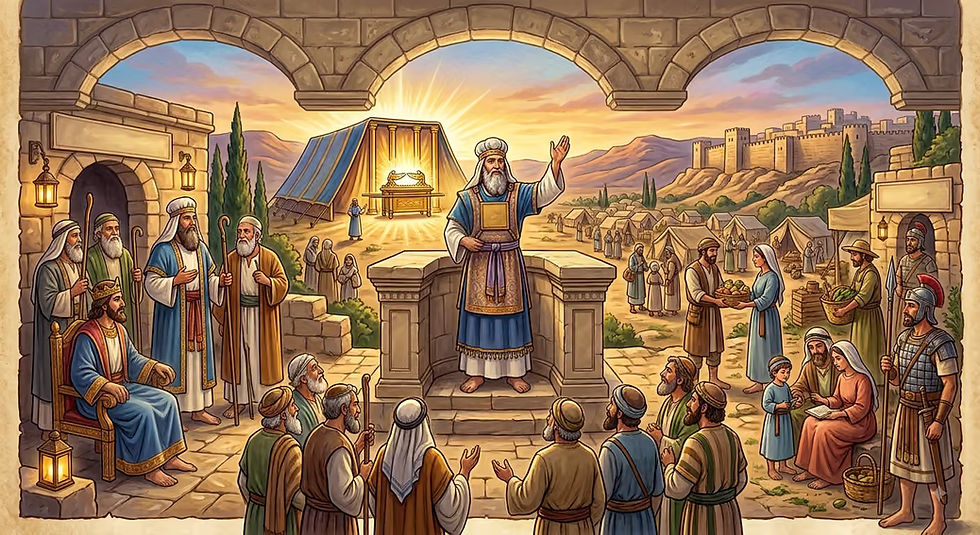
Parashat Shoftim—“Judges”—presents the Torah’s vision for building a righteous society in the Land of Israel. Moses addresses the institutions that will guide the nation after his passing: judges, officers, the supreme court, the king, the Kohanim and Levites, and the prophets.
Yet Shoftim is not merely a political constitution or legal handbook. It teaches that holiness must enter public institutions, leadership, warfare, criminal justice, interpersonal responsibility, and even the private “gates” through which a person receives and interprets the world.
The central message of the parashah is that Israel must not imitate the power structures of the surrounding nations. Every authority in Israel must remain subordinate to the Torah and to the sovereignty of the Creator.
1. “Judges and Officers You Shall Appoint”
“Judges and officers you shall appoint for yourself in all your gates.”
—Deuteronomy 16:18
The judges—shoftim—determine the law, while the officers—shotrim—ensure that the court’s decisions are carried out. Rashi explains that the judges issue rulings and the officers possess the authority necessary to implement those rulings. Torah justice therefore requires both correct understanding and faithful application.
The expression “for yourself” — לְךָ, lecha may also be read on a personal level. Before judging society, a person must establish judgment within oneself.
The Chassidic and Kabbalistic teachers interpret the “gates” as the gateways of the human personality: the eyes, ears, mouth, nose, thoughts, and emotions. A person must place an inner judge at these gates to determine what should be allowed to enter and what should be rejected. Torah learning functions like the judge, while the practical performance of the commandments acts like the officer who brings the judgment into action.
It is not enough to know what is right. The knowledge must govern speech, sight, hearing, relationships, business dealings, and personal conduct.
Spiritual lesson
A person should ask:
What am I allowing my eyes to see?
What voices am I allowing my ears to accept?
Are my words truthful, healing, and responsible?
Are my emotions governed by Torah wisdom?
Do I judge others by standards I refuse to apply to myself?
The first court a person must establish is the court within one’s own heart.
2. “They Shall Judge the People with Righteous Judgment”
The Torah does not merely command judges to reach technically legal decisions. It commands them to judge with mishpat tzedek—righteous judgment.
Justice must not be distorted through favoritism, social status, fear, political pressure, personal relationships, or financial influence. The Torah warns that bribery can blind even the wise and distort the words of the righteous.
Bribery does not refer only to money. A judge—or any person making a decision—may be influenced by praise, friendship, honor, ideology, anger, resentment, community pressure, or the desire to protect one’s reputation.
A person can therefore be sincerely convinced that he is acting justly while unknowingly being influenced by personal interest.
The Torah’s warning teaches humility: wisdom alone does not make someone immune to bias.
3. “Justice, Justice Shall You Pursue”
“Tzedek, tzedek tirdof—Justice, justice shall you pursue, so that you may live and possess the land.”
—Deuteronomy 16:20
Why is the word tzedek—justice repeated?
The Talmud explains that one expression refers to strict legal judgment and the other to peaceful compromise. There are situations where justice requires a formal ruling, and there are situations where justice is best achieved by bringing the parties toward a fair and peaceful settlement.
This teaches that Torah justice is not simply about declaring one person victorious and another defeated. Its deeper purpose is to restore order, truth, peace, and covenantal responsibility.
The repetition can also suggest:
Pursue a just outcome through just methods.
Seek justice both for yourself and for others.
Pursue justice whether it benefits you or costs you.
Examine both the external facts and your internal motives.
Continue pursuing justice consistently throughout life.
The Torah does not say merely, “Recognize justice.” It says, “pursue justice.” Justice must be actively sought. One must not remain passive when corruption, exploitation, false testimony, or the suffering of the vulnerable becomes visible.
At the same time, the method of pursuing justice must itself remain righteous. A holy objective cannot justify dishonest means.
4. The Torah’s Model of Leadership
Shoftim introduces several forms of leadership:
The judge, who interprets and applies Torah law.
The king, who governs the nation.
The Kohen and Levite, who serve in holiness and teach Torah.
The prophet, who communicates the Divine message.
No single office is permitted to possess unlimited authority. Torah leadership is distributed, accountable, and always subject to the word of God.
The king cannot redefine Torah.
The prophet cannot introduce idolatry or replace the commandments.
The judge cannot distort the law.
The Kohen cannot use holiness for personal domination.
This separation of authority prevents one leader from claiming absolute religious, political, judicial, and spiritual power.
Leadership as service
In the Torah, leadership is not ownership of the people. It is service to the people under the kingship of Heaven.
The leader is not above the covenant. The leader is the first person obligated to submit to it.
5. The King Must Carry the Torah
The Torah allows Israel to appoint a king but places strict boundaries around royal power. The king must not multiply horses, wives, silver, or gold. He must also write a Torah scroll and read from it throughout his life.
“So that his heart will not become elevated above his brothers.”
—Deuteronomy 17:20
The Torah does not deny the king authority, but it denies him self-exaltation.
A Torah king is still a brother among Israel. His position does not make him spiritually superior to the people he serves.
The restrictions address several dangers:
Many horses represent military dependence and the temptation to return to Egypt.
Many wives represent uncontrolled desire and political alliances that may turn the heart away from God.
Excessive wealth represents greed, oppression, and the illusion of self-sufficiency.
A lifted heart represents pride and separation from the people.
The king’s Torah scroll teaches that the ruler must be ruled by Torah. Political authority must kneel before Divine instruction.
Chassidic interpretation
Every person has a “king” within—the power of will and decision. That inner king must not be ruled by pride, appetite, wealth, or fear. It must continually read the Torah so that one’s decisions remain aligned with the Creator.
True kingship is not the freedom to do whatever one desires. It is the discipline to make one’s will serve the Divine will.
6. “You Shall Be Wholehearted with the Lord Your God”
“Tamim tihyeh im Hashem Elohecha—You shall be wholehearted with the Lord your God.”
—Deuteronomy 18:13
The Torah prohibits sorcery, divination, necromancy, consulting the dead, and other occult practices.
These prohibitions are not merely a rejection of foreign rituals. They teach Israel not to become enslaved to the desire to control the future.
Human beings often seek forbidden knowledge because uncertainty produces fear. The Torah responds by teaching temimut—wholehearted trust, simplicity, completeness, and undivided loyalty before God.
This does not mean intellectual ignorance. It means refusing to manipulate the spiritual world or seek unauthorized powers outside the Torah covenant.
A wholehearted person says:
“I will act responsibly, seek Torah wisdom, pray, repent, and make wise preparations—but I will not surrender my faith to superstition, divination, or spiritual manipulation.”
Shoftim contrasts pagan divination with authentic prophecy. Israel is not to chase secret powers. God will raise prophets when a Divine message is truly required.
7. The True Prophet
Moses tells Israel that God will raise a prophet from among their own people, and that the prophet will communicate what God commands.
However, the Torah also warns against false prophets. A person’s charisma, confidence, mystical vocabulary, signs, popularity, or claims of revelation do not automatically establish prophetic authority.
The Rambam explains that prophecy must be evaluated according to Torah-defined standards. A prophet who speaks falsely or claims a message not received from God cannot be accepted merely because the message sounds spiritual.
Most importantly, no genuine prophecy can cancel the Torah or lead Israel into idolatry.
Authentic prophetic leadership brings the people toward:
Loyalty to the Creator
Repentance
Justice
Compassion
Covenant faithfulness
Obedience to Torah
A spiritual voice that produces arrogance, idolatry, hatred, manipulation, or rejection of the commandments must be examined carefully.
8. The Authority of the Torah Court
When a legal question is too difficult for local judges, the matter must be brought to the central Torah authority.
This teaches that Torah cannot be reduced entirely to private interpretation. Personal study is essential, but difficult legal decisions require trained judges, received tradition, careful reasoning, and communal authority.
The Torah creates a relationship between the Written Torah, the interpretive tradition, and the recognized court.
Without disciplined interpretation, every person may claim that his own opinion represents God. The result would not be spiritual freedom but fragmentation.
At the same time, judges are not granted permission to act arbitrarily. Their authority exists only within Torah, justice, evidence, and responsibility.
9. Two Witnesses and the Danger of False Testimony
The Torah requires multiple witnesses in serious legal cases and establishes careful procedures for examining testimony.
This protects society from rumor, personal accusation, emotional reaction, and unsupported claims.
Shoftim teaches that truth must be established through evidence, not merely through repetition. A statement does not become true because many people share it, because it is emotionally powerful, or because it supports a preferred narrative.
The law of the edim zomemim—plotting witnesses demonstrates the seriousness of false testimony. Witnesses who conspire to harm an innocent person are held accountable for the punishment they attempted to impose.
The principle is spiritually significant: words can become instruments of violence. False testimony can destroy reputation, livelihood, family, freedom, and life.
Guarding one’s tongue is therefore part of pursuing justice.
10. Cities of Refuge: Justice with Mercy
The cities of refuge provide protection for a person who caused a death unintentionally.
The Torah distinguishes between intentional murder and accidental killing. This distinction reflects the balance between justice, accountability, and mercy.
The accidental killer is not treated as an intentional murderer, yet the loss of life is not dismissed as though nothing happened. Exile to a city of refuge creates protection, accountability, reflection, and separation from the circumstances surrounding the tragedy.
The Sages teach that the roads to the cities of refuge had to be properly prepared and clearly marked. Signs reading “Refuge” directed the fugitive toward safety.
This contains a profound spiritual lesson: society must not merely announce that repentance and restoration are possible. It must prepare the road.
There should be no unnecessary obstacles preventing a person from returning to God.
Communities must create clear pathways toward:
Teshuvah
Reconciliation
Rehabilitation
Torah learning
Responsible correction
Re-entry into communal life
Justice identifies wrongdoing. Mercy prepares a road toward repair.
11. Laws of Warfare: Even War Has Boundaries
Shoftim teaches that warfare does not suspend morality.
Israel is commanded not to panic before a powerful enemy, because victory does not depend exclusively upon numbers, horses, or military strength. The Kohen addresses the soldiers and reminds them that God accompanies Israel.
Certain individuals are permitted to return home: one who built a house but had not dedicated it, planted a vineyard but had not enjoyed its fruit, betrothed a woman but had not married her, or was fearful and fainthearted.
These exemptions show the Torah’s concern for human life, family, emotional condition, and unfinished responsibilities.
The Torah also prohibits the needless destruction of fruit trees during a siege:
“For the human being is a tree of the field.”
—Deuteronomy 20:19
This command becomes the foundation of the broader ethical principle known as bal tashchit—the prohibition against unnecessary destruction.
Even in conflict, human beings must resist cruelty, wastefulness, rage, and the desire to destroy simply because they possess the power to do so.
Power without restraint is not Torah strength.
12. The Unsolved Murder and the Eglah Arufah
The parashah concludes with the case of a murder victim found outside a city when the murderer is unknown.
The elders and judges measure the distance to the surrounding cities. The elders of the nearest city participate in the rite of the eglah arufah, the heifer whose neck is broken, and declare:
“Our hands did not shed this blood, and our eyes did not see.”
The Sages ask: Could anyone truly suspect the elders of murdering the victim?
The Talmud explains that the elders are declaring that they did not knowingly allow the person to leave without food, assistance, or accompaniment.
This is an extraordinary principle of communal responsibility.
The leaders may not have killed the victim directly, but they must still examine whether social neglect contributed to the tragedy.
They must ask:
Was the stranger welcomed?
Was the hungry person fed?
Was the traveller protected?
Was a vulnerable person sent away alone?
Did the community create conditions in which violence could flourish?
Were warning signs ignored?
The Torah teaches that innocence is not established merely by saying, “I did not personally commit the crime.”
A righteous society must also ask, “What did we fail to see?”
13. The Deeper Unity of Parashat Shoftim
At first, Shoftim appears to contain many separate laws: courts, kings, prophets, witnesses, refuge cities, warfare, trees, and unsolved murder.
Yet they are united by a single question:
How should power be governed by holiness?
Judicial power must serve justice.
Political power must submit to Torah.
Spiritual authority must remain faithful to God.
Military power must respect moral limits.
The power of speech must not become false testimony.
Community leaders must accept responsibility for the vulnerable.
Personal freedom must be guarded by inner judges.
Even the desire for spiritual knowledge must be restrained by wholehearted trust in God.
Shoftim teaches that holiness is not limited to prayer or the sanctuary. It must shape courts, governments, roads, armies, public safety, economic conduct, and community relationships.
Gaddi Efrayim Notes
1. Establish the kingdom of Heaven within
Before appointing judges over others, one must appoint a Torah judge over one’s own thoughts, desires, speech, and conduct.
The first question should not be, “Who is wrong around me?” but:
“What must be corrected within me?”
When the inner gates are unguarded, pride, anger, deception, idolatrous ideas, and harmful influences enter easily. Torah must stand at every gate.
2. The Torah is above every leader
Shoftim gives honor to judges, kings, priests, and prophets, but none of them may stand above Torah.
A leader who demands loyalty to himself instead of loyalty to the Creator has misunderstood Torah leadership.
True spiritual leadership does not create dependence upon a personality. It directs the people toward the One Creator, Torah, repentance, justice, and humble service.
3. “Justice, justice” means justice in both goal and method
It is not enough to defend a righteous cause. The cause must be pursued righteously.
False accusation, manipulation, humiliation, selective evidence, hatred, and dishonest teaching cannot become holy merely because they are used in the name of religion.
The Torah commands us to pursue justice through truth, patience, proper witnesses, careful interpretation, and fear of Heaven.
4. Guard against spiritual bribery
Just as money can blind a judge, religious emotion can blind a teacher.
A person may accept an interpretation because it confirms what he already wants to believe. This is a form of inward bribery.
Therefore, every teaching must be examined within the Torah framework, the writings of the Jewish sages, and responsible halachic interpretation.
Excitement must not replace truth.
5. The king remains a brother
The Torah’s leader must never elevate his heart above his brothers.
Leadership is not a throne of personal glory. It is a burden of accountability.
The greater the position, the greater the obligation to remain humble, approachable, transparent, and obedient to Torah.
A leader should not ask, “How can the people serve my vision?” but rather, “How can I help the people serve the Creator?”
6. Be wholehearted with the Creator
Shoftim rejects occult manipulation and the obsession with controlling the future.
Our trust is not in astrology, divination, magical objects, necromancy, or unauthorized spiritual powers. Israel is called to walk wholeheartedly with Hashem.
This wholeheartedness protects the soul from avodah zarah and from fear-based spirituality.
We study Torah, seek wise counsel, pray, repent, and act responsibly. The hidden future remains in the hands of the Creator.
7. Build roads of refuge
A Torah community must create clear paths for people who desire repentance and restoration.
It should not confuse mercy with the denial of wrongdoing. Neither should it use justice as an excuse to permanently crush a repentant person.
The city of refuge teaches that accountability and protection can exist together.
Let every Torah institution become a place where the road to teshuvah is clearly marked.
8. Do not ignore the person outside the city
The closing passage concerning the unsolved murder teaches that leadership must look beyond the walls of the community.
A congregation may possess beautiful teachings, programs, buildings, and ceremonies, yet still fail the lonely traveller, the hungry person, the wounded soul, or the forgotten stranger.
The elders must ask not only, “Did we teach Torah?” but also:
Did we notice the vulnerable?
Did we accompany those travelling alone?
Did we provide spiritual and practical nourishment?
Did our community protect human dignity?
Did anyone leave us feeling abandoned?
Torah leadership requires open eyes.
9. The messianic repair begins with righteous judgment
The prophets describe redemption as a restoration of righteous judgment. The future renewal of Israel is therefore not merely miraculous; it includes the rebuilding of trustworthy leadership, honest courts, wise counsel, and societies governed by Torah justice. This theme is echoed in Chassidic discussions linking the appointment of judges with the prophetic promise that righteous judges will be restored.
The preparation for redemption begins whenever a person replaces prejudice with truth, corruption with integrity, cruelty with responsibility, and spiritual confusion with wholehearted loyalty to Hashem.
Conclusion
Parashat Shoftim teaches that a holy nation requires more than religious inspiration. It requires righteous institutions, disciplined leaders, reliable testimony, moral restraint, communal responsibility, and guarded human hearts.
The command “Justice, justice shall you pursue” is not addressed only to judges. It is addressed to every generation and every soul.
We must establish judges at our personal gates, place Torah above human authority, reject idolatrous and manipulative spirituality, protect the innocent, create roads for repentance, restrain power, and take responsibility for those who might otherwise be forgotten.
When justice is joined with mercy, leadership with humility, and authority with Torah, society becomes a dwelling place for the Divine Presence.
Beit Yisrael International – Gaddi Efrayim Notes


Comments