


Hoshana Rabbah —הוֹשַׁעְנָא רַבָּה-Friday, October 2, 2026 / 21 Tishrei, 5787-Hoshana Rabbah (Chol Hamoed Sukkot)

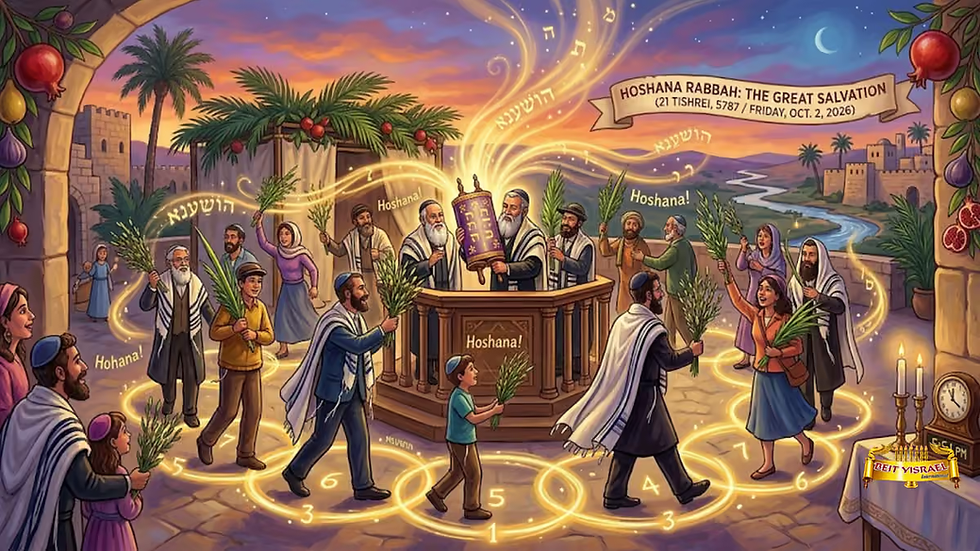
The Meaning of Hoshanah Rabbah
Hoshana means “save” and is the recurring refrain of the Hoshaanot ceremony performed every day of Sukkot. Hoshana Rabbah, “the great Hoshana,” was thus named because we repeat this ritual, during which we solemnly circle the Torah, seven times on this day, instead of just once as we had done in the previous days.The name can be read to mean “great salvation.”
“The Great ‘Please Save Us’”
The expression הוֹשַׁע נָא— Hosha na means essentially, “Please save!” or “Please bring deliverance!” The seventh day of Sukkot is therefore not simply another festival day. It gathers together the themes of judgment, teshuvah, water, Divine blessing, the altar, the willow, and the descent of spiritual blessing into actual life.
Its spiritual movement can be expressed as:Rosh Hashanah → judgment is awakenedYom Kippur → judgment is sealed through teshuvah and atonementSukkot → the renewed person enters Divine embraceHoshana Rabbah → blessing is drawn downward into actual life
That final line is a mystical synthesis, but it accurately captures the direction of the later tradition.
1. The first judgment: Rosh Hashanah
The Mishnah teaches:
בְּרֹאשׁ הַשָּׁנָה כָּל בָּאֵי עוֹלָם עוֹבְרִין לְפָנָיו כִּבְנֵי מָרוֹן
“On Rosh Hashanah all who enter the world pass before Him like benei maron.”
Rosh Hashanah 16a then discusses the relationship between judgment on Rosh Hashanah and its sealing on Yom Kippur.
Rosh Hashanah therefore concerns:Who am I before the King?
It is the awakening of Din — דין, judgment.
The shofar penetrates the person's inner being.
2. Yom Kippur — the seal
The same Talmudic discussion states that mankind is judged on Rosh Hashanah and the decree is sealed on Yom Kippur.
This is the classical Talmudic formulation.
Yom Kippur concerns:Can the person be cleansed and restored?
The dominant movement is inward:Teshuvah → Vidui → Kapparah → Taharah
The person withdraws from eating, drinking and ordinary bodily pleasure.
Thus Yom Kippur is overwhelmingly a day of inner purification.
3. Hoshana Rabbah — judgment moves into the world
Later Jewish mystical tradition adds another stage. The Zohar describes the last days of the festival using the metaphor of pitkin — פתקין, written decrees or notes emerging from the King's palace. It also stresses that teshuvah can still transform the judgment.
That gives us a useful distinction:
Yom Kippur
חתימה — ChatimahSealing.
Hoshana Rabbah
The decree approaches execution or manifestation.
So Hoshana Rabbah is not best understood as “Yom Kippur failed, therefore another Yom Kippur is necessary.” Rather:
Yom Kippur concerns the decree in its spiritual root.Hoshana Rabbah concerns its movement from spiritual potential toward earthly reality.
This is why later tradition sometimes calls it a kind of:
חותם בתוך חותם
Chotam betoch chotam
“A seal within the seal.”
The metaphor is mystical rather than the plain halakhic statement of the Mishnah.
4. From the “seal of the heart” to the “seal of action”
Your distinction between an inward seal and an outward seal is particularly meaningful in this framework. Yom Kippur is primarily associated with:
mindheartrepentanceconfessionintention
But Sukkot immediately returns the person to:
eatingdrinkingdwellingwalkingholdingrejoicing
The holiness gained inwardly must now enter bodily existence.
So we may formulate:
Yom Kippur asks:“What has happened to your soul?”
Hoshana Rabbah asks:“Will that transformation now enter your hands, feet, livelihood, relationships and actions?”
Hence the movement:Kavanah → Ma'asehIntention → ActionNeshamah → GufSoul → BodyHeaven → Earth
This connects directly with the Sukkah concept we discussed earlier: Sukkot is precisely where the upper and lower realms become joined.
5. Why is Hoshana Rabbah connected specifically with water?
The Mishnah states:
וּבֶחָג נִדּוֹנִין עַל הַמָּיִם
“On the Festival [Sukkot], judgment is passed concerning water.”
The Gemara then explains that the water libation is associated with blessing for the rains of the coming year. This is much deeper than agriculture alone.
Without rain there is:no crop,no fruit,no livestock sustenance,no livelihood,no physical survival.
Thus water represents the transition between Divine blessing and earthly life.
Rain literally performs:
Heaven → Earth.
That makes water the ideal symbol for Hoshana Rabbah. The whole spiritual drama of the day concerns:
Will what exists above descend below?
6. Water and Torah
Jewish tradition repeatedly uses water as a metaphor for Torah. Just as water descends from a higher place to a lower place, Torah descends from Divine wisdom into human consciousness. This becomes especially significant on Hoshana Rabbah.
There are therefore two kinds of rain:
גשם — Geshem
Physical rain.
And symbolically:
Shefa — שפע
Divine flow or abundance.
We pray that the coming year receive not only water for the earth but also:
wisdomTorahparnassahhealingpeaceclarityspiritual vitality.
Thus the prayer for rain becomes a prayer that the Divine flow not remain trapped in potential.Let it descend.
7. A remarkable word connection: Geshem and Gashmiyut
There is a beautiful conceptual relationship in later Jewish thought between:גֶּשֶׁם — geshem — rainandגַּשְׁמִיּוּת — gashmiyut — physicality/material existence.
Hoshana Rabbah therefore concerns the descent of blessing specifically into gashmiyut. Not holiness only in the synagogue. Not holiness only during prayer. But holiness expressed through:
health,livelihood,food,home,family,community,the physical world.
This is crucial. Judaism does not seek salvation from creation. Its goal is often expressed as the sanctification of creation.
8. Why the willow?
Now we reach one of the deepest symbols of the day. The Torah's aravah — ערבה, willow, grows beside water. In the Four Species tradition, the willow is understood as lacking both noticeable taste and fragrance.
Rabbinic Midrash famously interprets the Four Species as representing different kinds of Jews:
Etrog — taste and fragranceTorah and good deeds.Lulav/date palm — taste without fragrance.Hadas/myrtle — fragrance without taste.Aravah/willow — neither.
Yet the Torah still commands that the willow be included. That is extraordinary.
The willow declares:
Even the Jew who appears to possess neither Torah learning nor distinguished deeds remains inseparably part of Israel.
The Divine embrace does not abandon him.
9. Why does Hoshana Rabbah elevate precisely the willow?
During most of Sukkot the willow is bound together with the other species. On Hoshana Rabbah, however, the willow obtains a separate ritual identity. The Gemara records that the independent willow ceremony is an ancient prophetic institution or custom, associated with the later prophets. And in the Temple, great willow branches surrounded the altar. The Mishnah describes the altar processions, with seven circuits on the seventh day.
So the humblest species eventually receives its own day.
Mystically, this is very significant. The final Divine blessing does not depend entirely upon spiritual sophistication. At the deepest level the Jew stands before HaShem simply because:
I belong to You.
That is temimut — תמימות, simple wholeness.
10. The willow and simple faith
The willow does not say:“I deserve because of my wisdom.”It does not say:“I deserve because of my spiritual fragrance.”It simply stands beside the water.
This becomes an image of:
אמונה פשוטה
Emunah peshutah
Simple faith.At the end of an enormous spiritual journey—Elul,Selichot,Rosh Hashanah,Ten Days of Teshuvah,Yom Kippur,Sukkot—we finally arrive at something simpler than all theology:
“HaShem, save us.”
הוֹשַׁע נָא
No argument.No spiritual résumé.No declaration of achievement.Only dependence upon Divine mercy.
11. Why strike the willow?
Sukkah 44a–b records the ancient willow practice, while later custom developed the familiar beating of the willow branches.
Kabbalistic and Chassidic interpretations understand the beating in terms of gevurot — severities/judgments becoming sweetened. A Chabad source, explaining this mystical tradition, describes the willow beating as drawing down sweetened attributes of severity, so that severity itself ultimately becomes revealed kindness.
This is subtler than simply saying:“We beat away evil.”The mystical idea is:Din is not necessarily destroyed.It is hamtakat ha-dinim — המתקת הדינים, sweetening the judgments.Judgment is transformed.Restriction becomes channel.Severity becomes productive discipline.The thing that could have blocked blessing becomes a vessel for blessing.
12. Why strike it specifically on the earth?
Here we can make a profound synthesis.
The willow begins beside water.Then it is brought into prayer.Finally it strikes earth.
So the imagery becomes:Water → Willow → Earthor:Shefa → vessel → manifestation
The heavenly flow must reach the lowest world.This returns us to the theme we developed earlier:
Heaven and earth “kiss” in the Sukkah.
On Hoshana Rabbah, the movement reaches its lowest point:
the ground itself.
The blessing has to touch aretz — earth.Not remain abstract.
13. Seven circuits — completion
In the Beit HaMikdash, the altar was circled once on the ordinary days of Sukkot but seven times on the seventh day. Seven in Torah repeatedly represents a completed created order:seven days of Creation,seven days of Sukkot,seven weeks toward Shavuot,seven-year Shemittah cycles.
Therefore the seventh day and seven circuits naturally convey:
Completion.
Hoshana Rabbah is the closing movement of the sevenfold Sukkot cycle.The entire created order is symbolically brought around the altar.And the central cry becomes:
אָנָּא ה׳ הוֹשִׁיעָה נָּא
Ana Hashem hoshiah na
“Please, HaShem, save now.”
14. The altar is the center
This is essential.The willow procession historically centered not merely around the sukkah but around the mizbe'ach — altar.Why?
The altar represents the place where physical creation is elevated:animal,grain,wine,water.All these physical elements are brought into Divine service.
Thus Hoshana Rabbah's altar procession repeats the entire theological message of Sukkot:Creation itself must return toward its Source.And Divine blessing must then return toward Creation.Upward:earth → HeavenDownward:Heaven → earthThe altar stands at that junction.
15. Hoshana Rabbah and the Seven Ushpizin
There is another beautiful layer.Each day of Sukkot is traditionally associated with one of the seven Ushpizin.In the common order:
Avraham
Yitzchak
Yaakov
Moshe
Aharon
Yosef
David
Thus Hoshana Rabbah is especially associated with David HaMelech.David corresponds in Kabbalistic symbolism with:
מלכות — Malchut
Kingship.And Malchut has a special function:It receives from all the preceding sefirot and transmits their influence into manifested reality.This fits Hoshana Rabbah perfectly.The first six days accumulate spiritual influence.The seventh gathers everything into:
Malchut.
Into kingdom.Into reality.Into the world.
16. David and “I have nothing of my own”
Kabbalistic literature frequently describes Malchut as:לית לה מגרמה כלום“It has nothing of its own.”It receives from above.
This sounds almost exactly like the willow.The willow possesses:neither tastenor fragrance.Malchut possesses nothing “of itself.”Yet precisely because it receives, it can become the place through which all higher influence enters reality.
Thus:Willow ↔ MalchutHoshana Rabbah ↔ seventh dayDavid ↔ seventh UshpizinRain ↔ descentEarth ↔ receptionThese symbols converge beautifully.
17. The deepest cry: “Hoshana”
The theological center of the day may therefore not be judgment at all.It is dependence.Hoshana — Save us.This is the voice of Malchut.The vessel says to the Source:I cannot produce life from myself.Earth cannot command rain.The body cannot manufacture neshamah.Creation cannot become its own Creator.Israel therefore stands with the simplest branch and says:
“Everything comes from You.”
That humility itself becomes the vessel for blessing.
18. Judgment transformed into joy
Hoshana Rabbah has an unusual character.It is solemn because of judgment.Yet it remains Sukkot—
זמן שמחתנו
Zman Simchateinu
“The season of our rejoicing.”So the final judgment occurs inside joy.This is spiritually different from fear alone.Rosh Hashanah emphasizes awe.Yom Kippur emphasizes purification.Hoshana Rabbah joins seriousness with joy.Why?Because once teshuvah has occurred, judgment is no longer merely experienced as rejection.It can be understood as clarification preparing a vessel for blessing.
19. From King → Father → Embrace → Life
Building on the framework you have been developing, I would express the Tishrei journey this way:
Rosh Hashanah — The King
מלך — MelechHaShem reveals sovereignty.“Stand before Me.”↓
Yom Kippur — The Father
אב — AvThrough teshuvah, forgiveness and purification:“Return to Me.”↓
Sukkot — The Embrace
חיבוק — ChibukThrough the Sukkah:“Dwell with Me.”↓
Hoshana Rabbah — The Flow of Life
שפע החיים — Shefa HaChayimThrough water and willow:“Receive My blessing and carry it into the world.”This last language is an interpretive spiritual framework rather than a verbatim classical text, but it faithfully connects the major symbols.
Gaddi Efrayim Notes
Hoshana Rabbah — When Heaven's Blessing Touches Earth
Hoshana Rabbah reveals the final mystery of the Tishrei journey.On Rosh Hashanah, man stands before the King.On Yom Kippur, the returning child stands before the Father.On Sukkot, he enters the Divine embrace.But on Hoshana Rabbah, the embrace must become life.The blessing must descend from the heavenly realm into the world of action.
Therefore the central symbol is water.Water begins above and falls below.It does not remain in Heaven.It descends until it touches earth and causes hidden seeds to live.
So too, Torah, teshuvah, mercy and Divine blessing cannot remain only spiritual ideas.They must descend into:the body,the home,the family,livelihood,relationships,community,and every physical action.
And therefore we take the humble aravah.The willow has neither taste nor fragrance.It does not boast of wisdom.It does not boast of achievement.It simply stands before HaShem and cries:
הוֹשַׁע נָא
Hosha Na
“Please save.”
This is the deepest vessel.When the ego becomes quiet, Divine flow can descend.When the willow touches the earth, the spiritual journey touches physical reality.
Thus Hoshana Rabbah may be understood as:
The Day Heaven's Decree Becomes Earth's Blessing
Rosh Hashanah awakens the judgment.Yom Kippur seals repentance and atonement.Sukkot surrounds the renewed soul with Divine peace.Hoshana Rabbah brings that holiness downward into life.
The final destination of holiness is therefore not escape from the physical world.It is:
שמים בתוך הארץ — Shamayim betoch ha'aretz
“Heaven within the earth.”
And this is the inner cry of Hoshana Rabbah:“HaShem, let what has been awakened above now descend below. Let judgment become mercy, water become life, teshuvah become action, and Your Presence become visible within our world.”
— Beit Yisrael International – Gaddi Efrayim Notes
Seven Circuits of Hoshana Rabbah
For Hoshana Rabbah, the congregation makes seven hakafot (circuits) around the bimah, recalling the seven circuits around the altar in the Beit HaMikdash. The followed by the traditional Seven Wedding Blessings — Sheva Brachot, which are the standard “seven wedding prayers.”
Seven Circuits of Hoshana Rabbah
The central cry is:
הוֹשַׁע נָא
Transliteration:Hosha na.Translation:“Please save us.” / “Please bring salvation.”
A central verse repeated in the Hoshana service is:
אָנָּא יְיָ הוֹשִׁיעָה נָּאאָנָּא יְיָ הַצְלִיחָה נָּא
Transliteration:Anna Adonai, hoshi'ah na;Anna Adonai, hatzlichah na.Translation:“Please, HaShem, save us now.Please, HaShem, grant us success now.”
On the first six days of Sukkot the bimah is circled once; on Hoshana Rabbah it is circled seven times, commemorating the Temple service in which the altar was circled seven times on the seventh day.
A simple devotional structure for the seven circuits can be expressed as:
הוֹשַׁע נָא — Hosha Na — Save us.
אָנָּא ה׳ הוֹשִׁיעָה נָּא — Anna Hashem Hoshi'ah Na — HaShem, please save us.
אָנָּא ה׳ הַצְלִיחָה נָּא — Anna Hashem Hatzlichah Na — HaShem, please grant success.
רַחֵם עָלֵינוּ — Rachem Aleinu — Have mercy upon us.
זָכְרֵנוּ לְחַיִּים — Zochreinu LeChayim — Remember us for life.
כָּתְבֵנוּ לְחַיִּים טוֹבִים — Kotveinu LeChayim Tovim — Inscribe us for a good life.
הוֹשַׁע נָא לְמַעַן שְׁמֶךָ — Hosha Na Lema'an Shemecha — Save us for the sake of Your Name.
Sheva Brachot — שבע ברכות
The Seven Jewish Wedding Blessings
These are the traditional seven blessings recited beneath the chuppah. They praise creation, humanity, Zion, the bride and groom, and the restoration of joy in Jerusalem.
1. Blessing over the wine
Hebrew
בָּרוּךְ אַתָּה יְיָ אֱלֹהֵינוּ מֶלֶךְ הָעוֹלָם,בּוֹרֵא פְּרִי הַגָּפֶן.
TransliterationBaruch Atah Adonai, Eloheinu Melech ha-olam,borei peri ha-gafen.
Translation“Blessed are You, HaShem our God, King of the universe, who creates the fruit of the vine.”
2. All creation is for His glory
Hebrew
בָּרוּךְ אַתָּה יְיָ אֱלֹהֵינוּ מֶלֶךְ הָעוֹלָם,שֶׁהַכֹּל בָּרָא לִכְבוֹדוֹ.
TransliterationBaruch Atah Adonai, Eloheinu Melech ha-olam,shehakol bara lichvodo.
Translation“Blessed are You, HaShem our God, King of the universe, who created everything for His glory.”
3. Creator of humanity
Hebrew
בָּרוּךְ אַתָּה יְיָ אֱלֹהֵינוּ מֶלֶךְ הָעוֹלָם,יוֹצֵר הָאָדָם.
TransliterationBaruch Atah Adonai, Eloheinu Melech ha-olam,yotzer ha-adam.
Translation“Blessed are You, HaShem our God, King of the universe, Creator of humanity.”
4. Humanity created in the Divine image
Hebrew
בָּרוּךְ אַתָּה יְיָ אֱלֹהֵינוּ מֶלֶךְ הָעוֹלָם,אֲשֶׁר יָצַר אֶת הָאָדָם בְּצַלְמוֹ,בְּצֶלֶם דְּמוּת תַּבְנִיתוֹ,וְהִתְקִין לוֹ מִמֶּנּוּ בִּנְיַן עֲדֵי עַד.בָּרוּךְ אַתָּה יְיָ, יוֹצֵר הָאָדָם.
Transliteration
Baruch Atah Adonai, Eloheinu Melech ha-olam,asher yatzar et ha-adam betzalmo,betzelem demut tavnito,vehitkin lo mimenu binyan adei ad.Baruch Atah Adonai, yotzer ha-adam.
Translation
“Blessed are You, HaShem our God, King of the universe, who fashioned humanity in His image, in the image of the likeness of His form, and prepared from him an everlasting structure. Blessed are You, HaShem, Creator of humanity.”
5. Rejoicing of Zion
Hebrew
שׂוֹשׂ תָּשִׂישׂ וְתָגֵל הָעֲקָרָה,בְּקִבּוּץ בָּנֶיהָ לְתוֹכָהּ בְּשִׂמְחָה.בָּרוּךְ אַתָּה יְיָ,מְשַׂמֵּחַ צִיּוֹן בְּבָנֶיהָ.
Transliteration
Sos tasis vetagel ha-akarah,bekibbutz baneha letochah besimchah.Baruch Atah Adonai,mesame'ach Tziyon bevaneha.
Translation
“May the barren one greatly rejoice and exult when her children are gathered into her in joy. Blessed are You, HaShem, who causes Zion to rejoice with her children.”
This blessing links the personal wedding to the larger restoration and joy of Zion.
6. Joy of bride and groom
Hebrew
שַׂמֵּחַ תְּשַׂמַּח רֵעִים הָאֲהוּבִים,כְּשַׂמֵּחֲךָ יְצִירְךָ בְּגַן עֵדֶן מִקֶּדֶם.בָּרוּךְ אַתָּה יְיָ,מְשַׂמֵּחַ חָתָן וְכַלָּה.
Transliteration
Same'ach tesamach re'im ha-ahuvim,kesamechacha yetzircha beGan Eden mikedem.Baruch Atah Adonai,mesame'ach chatan vekallah.
Translation
“Cause the beloved companions to rejoice greatly, as You caused Your creation to rejoice in the Garden of Eden in ancient times. Blessed are You, HaShem, who causes bridegroom and bride to rejoice.”
This blessing explicitly connects marriage to Gan Eden, presenting the couple as a renewal of the primordial union.
7. The great blessing of joy
Hebrew
בָּרוּךְ אַתָּה יְיָ אֱלֹהֵינוּ מֶלֶךְ הָעוֹלָם,אֲשֶׁר בָּרָא שָׂשׂוֹן וְשִׂמְחָה,חָתָן וְכַלָּה,גִּילָה רִנָּה דִּיצָה וְחֶדְוָה,אַהֲבָה וְאַחֲוָה וְשָׁלוֹם וְרֵעוּת.מְהֵרָה יְיָ אֱלֹהֵינוּ יִשָּׁמַעבְּעָרֵי יְהוּדָה וּבְחוּצוֹת יְרוּשָׁלַיִם,קוֹל שָׂשׂוֹן וְקוֹל שִׂמְחָה,קוֹל חָתָן וְקוֹל כַּלָּה,קוֹל מִצְהֲלוֹת חֲתָנִים מֵחֻפָּתָםוּנְעָרִים מִמִּשְׁתֵּה נְגִינָתָם.בָּרוּךְ אַתָּה יְיָ,מְשַׂמֵּחַ חָתָן עִם הַכַּלָּה.
Transliteration
Baruch Atah Adonai, Eloheinu Melech ha-olam,asher bara sason vesimchah,chatan vekallah,gilah, rinah, ditzah vechedvah,ahavah ve'achavah veshalom vere'ut.Meherah Adonai Eloheinu yishamabe'arei Yehudah uvechutzot Yerushalayim,kol sason vekol simchah,kol chatan vekol kallah,kol mitzahalot chatanim mechuppatam,unearim mimishteh neginatam.Baruch Atah Adonai,mesame'ach chatan im hakallah.
Translation
“Blessed are You, HaShem our God, King of the universe, who created joy and gladness, bridegroom and bride, rejoicing, song, delight and celebration, love, brotherhood, peace and friendship.Soon, HaShem our God, may there be heard in the cities of Judah and in the streets of Jerusalem the sound of joy and the sound of gladness, the voice of the bridegroom and the voice of the bride, the jubilant voices of bridegrooms from their chuppot and of young people from their feasts of song.Blessed are You, HaShem, who causes the bridegroom to rejoice with the bride.”
The sevenfold connection
There is a beautiful symbolic parallel, though these are two distinct ceremonies:
Hoshana Rabbah:7 circuits → altar → water → salvation → completion
Jewish Wedding:7 blessings → chuppah → bride and groom → joy → new household
Both use the number seven as a language of completing a sacred structure. The wedding speaks about building a בִּנְיַן עֲדֵי עַד — binyan adei ad, “an everlasting structure,” while Hoshana Rabbah completes the seven-day Sukkot cycle through seven circuits.
Chassidut: The Seven Circuits, the Chuppah, and the Seven Blessings
In Chassidic thought, Hoshana Rabbah and the Jewish wedding share a striking spiritual pattern: both use the number seven to bring a higher, encompassing holiness into actual life. This does not mean that the seven Hoshana Rabbah circuits are literally the same institution as the Sheva Brachot. They are distinct mitzvah-custom frameworks. But Chassidut allows us to see a shared inner architecture: sevenfold completion, surrounding Divine light, union, joy, and the drawing of blessing into Malchut—the revealed world.
The classical wedding blessings themselves move from Creation and humanity toward Zion, bride and groom, joy, love, peace, and Jerusalem. The Talmud places the Birkat Chatanim within a sevenfold structure, and the later wedding service uses them under the chuppah as part of nisu'in.
1. Seven means the completion of the created world
Chassidut repeatedly reads seven as the structure through which Divine vitality becomes organized within creation.
There are seven days of Creation and, in Kabbalah, seven lower middot:
Chesed — חסדlovingkindness
Gevurah — גבורהstrength/restraint
Tiferet — תפארתharmony
Netzach — נצחendurance
Hod — הודsurrender/splendor
Yesod — יסודbonding/foundation
Malchut — מלכותreceptivity/kingdom
Therefore, seven movements do not merely mean “repeat something seven times.” Mystically they imply:
Let the holiness pass through every emotional dimension until it reaches Malchut and becomes manifest.
This is especially fitting for Hoshana Rabbah, the seventh day of Sukkot.
2. Hoshana Rabbah: seven circuits around the center
On Hoshana Rabbah the bimah is circled seven times, recalling the seven circuits around the altar in the Temple. The day is also understood in later Jewish tradition as the final stage in the year's judgment process.
The important Chassidic question is:
Why circle?
A straight line moves from one point toward another. A circle, however, surrounds a center.
This creates the language of:
אוֹר מַקִּיף — Or Makif
Encompassing Light
Some Divine influence enters the mind and heart in an internalized way—or penimi. But another level is too great to be grasped internally. It surrounds.
Sukkah itself is one of the clearest physical metaphors for this: the person enters a mitzvah that surrounds the entire body.
Similarly, the hakafah—circling—expresses relationship to something beyond ordinary intellectual grasp. You do not merely stand before the center. You orient your entire movement around it.
3. The center does not move
Consider the physical symbolism.
The congregation moves. The Torah/bimah or, in the Temple model, the altar remains the center.
Spiritually this means:
Man changes.The Divine center remains.
During Elul and Tishrei we move through:
Teshuvah,shofar,fasting,confession,Sukkah,lulav,joy,water,willow.
But HaShem remains the axis.
The seven hakafot therefore teach:
Do not make yourself the center and ask God to orbit you.
Instead:
Make HaShem the center, and reorganize your life around Him.
That is a deeply Chassidic reading of bittul—self-nullification before the Divine purpose.
4. Seven circuits as seven middot
We can therefore understand the seven Hoshana Rabbah circuits as an inner spiritual journey.
First circuit — Chesed
“Let my love revolve around You.”Love must no longer be merely personal desire.It becomes Divine service.
Second — Gevurah
“Let my restraint revolve around You.”Strength is sanctified.Judgment becomes discipline rather than harshness.
Third — Tiferet
“Let truth and compassion meet around You.”The opposites of love and restraint become harmony.
Fourth — Netzach
“Let my persistence serve You.”Determination becomes holy endurance.
Fifth — Hod
“Let my ego bow before You.”Instead of self-display:Hoda'ah — הודאה, acknowledgment and surrender.
Sixth — Yesod
“Let my relationships become channels of holiness.”Yesod binds and transmits.
Seventh — Malchut
“Let everything become actual.”Now the blessing enters:speech,action,home,community,earth.
Thus the seventh circuit represents not simply another level.It is the point at which all previous six become realized.
5. This is why Hoshana Rabbah belongs to Malchut
In the traditional Ushpizin sequence, the seventh day corresponds to David HaMelech, who is associated in Kabbalah with Malchut.
Malchut possesses nothing independently; its greatness is its capacity to receive and reveal what comes from above.
That is why Malchut is compared to:the moon receiving sunlight,speech revealing thought,earth receiving rain,and kingship manifesting authority.
Hoshana Rabbah therefore asks:
Will everything awakened during Tishrei actually descend into life?
That is the Malchut-question.Rosh Hashanah can remain an inspiration.Yom Kippur can remain a holy memory.Sukkot can remain an emotional experience.But Malchut asks:
“What will you actually do?”
6. The wedding chuppah expresses the same idea of Makif
Now consider the Jewish wedding. The bride and groom stand under the chuppah. Kabbalistic and Chassidic language sees an important symbolism here:
something higher surrounds both of them.
Neither spouse is the ultimate center. Both stand beneath a reality greater than themselves.
The chuppah therefore resembles the concept of Or Makif.
The marriage begins not only by saying:“I choose you.”But spiritually:“We both enter something greater than either of us individually.”
This is why the chuppah is such a powerful image.The higher light does not belong exclusively to groom or bride.It encompasses both.
7. Sukkah and chuppah: two forms of Divine enclosure
Here the parallel becomes beautiful.
Sukkah
The person enters a Divine enclosure.
Chuppah
The bride and groom enter a sacred enclosure.
In both cases:the surrounding space changes the meaning of those standing inside it.
Outside, eating may simply be eating.Inside the sukkah, eating becomes part of the mitzvah of dwelling.Outside, two individuals remain two independent persons.Under the chuppah, they enter a covenantal household.
So the spiritual logic is:
Makif creates the vessel in which unity can occur.
8. The Sheva Brachot bring this surrounding blessing inward
The seven blessings are not only prayers for private romantic happiness. Their scope becomes progressively larger. They mention:creation,humanity,the Divine image,an everlasting structure,Zion,Gan Eden,love,friendship,peace,Jerusalem.
The wedding is therefore inserted into the whole story of Creation and redemption.[ ](https://www.chabad.org/library/article_cdo/aid/313725/jewish/The-Seven-Benedictions-Sheva-Berakhot.htm?utm_source=chatgpt.com)
This is profoundly Chassidic.Marriage is not:two people creating a private world detached from everything else.It becomes:two souls building a dwelling within HaShem's greater purpose for Creation.
9. “Binyan Adei Ad” — building eternity inside physical life
One of the Sheva Brachot says:
בִּנְיַן עֲדֵי עַד
Binyan Adei Ad
“An everlasting structure.”
This expression deserves special attention.A marriage is created through very physical things:a home,food,work,children where blessed,money,daily responsibilities,ordinary conversation.
Yet the blessing calls this:
an eternal building.
This is exactly the Chassidic principle of making a:
דִּירָה בְּתַחְתּוֹנִים — Dirah Betachtonim
“a dwelling for HaShem in the lower realms.”
The highest Divine purpose is not fulfilled by abandoning physical reality but by transforming physical reality into a home for holiness.Marriage becomes one of the deepest expressions of that principle.
10. Bride and groom: giver and receiver, then something higher
Kabbalistic language sometimes describes the masculine principle as mashpia, giver, and the feminine as mekabel, receiver.
But Chassidut does not leave the relationship at a simplistic one-way flow. The final wedding blessing says:
מְשַׂמֵּחַ חָתָן עִם הַכַּלָּה
Mesame'ach chatan im hakallah
“Who causes the groom to rejoice with the bride.”
The final unity is not domination of giver over receiver. It is mutual joy within a higher unity. Indeed, the Sheva Brachot culminate in:
אהבה — ahavah — loveאחוה — achvah — brotherhoodשלום — shalom — peaceרעות — re'ut — companionship
The wedding blessings explicitly culminate in this language of love, friendship, harmony, and Jerusalem.
11. Shalom is the secret connecting wedding and Sukkah
Earlier we explored:
סֻכַּת שְׁלוֹמֶךָ
Sukkat Shelomecha“Your sukkah of peace.”
Now notice that the final wedding blessing also emphasizes:
שָׁלוֹם וְרֵעוּת
Shalom ve-re'ut“Peace and companionship.”
So both Sukkah and marriage aim toward shalom.
But shalom in Torah is more than absence of conflict. True shalom means:
opposites remain distinct yet become part of one greater unity.
Man and woman do not become identical. Heaven and earth do not become identical. Body and soul do not become identical. Chesed and Gevurah do not become identical. But a higher Divine unity allows them to coexist harmoniously. That is Tiferet, and ultimately Shalom.
12. Hakafot and the marriage circle
Here we must distinguish custom carefully. In many Ashkenazi wedding traditions the bride circles the groom seven times, although practices differ among communities. Chassidic interpretations often understand this in terms of creating a spiritual enclosure around the new household. Whether we look at those wedding circles or the seven Hoshana Rabbah hakafot, the imagery is parallel:
seven movements create a complete sacred boundary.
Inside that boundary, something new is formed. At Hoshana Rabbah:the new year's blessing is drawn toward manifestation.
At marriage:a new household is established.
One is cosmic. One is personal. Both involve:
seven → enclosure → union → manifestation.
13. From circle to line
Chassidut frequently distinguishes between:
עִגּוּלִים — Igulim
Circles
and
יוֹשֶׁר — Yosher
Ordered/direct structure.
A circle represents transcendence and equality: every point of the circumference relates to the center. A line represents differentiated structure: higher/lower, beginning/end, channels of transmission.
This gives us a beautiful way to understand the festivals. During hakafot:
first we enter the circle.
The relationship transcends intellectual distinctions. Then afterward:
we must draw the circle into the line.
Meaning: the transcendent experience must enter ordinary sequence: morning, work, family, money, speech, mitzvot, daily choices.
Otherwise makif remains merely surrounding inspiration. The goal is:
Makif → Penimi
Surrounding holiness → Internalized holiness.
14. This is also the purpose of marriage
The chuppah is a makif. But the couple cannot live their entire marriage standing under a canopy. They eventually leave the chuppah. That is precisely the point. What surrounded them must now become internalized through: patience, speech, chesed, faithfulness, forgiveness, shared responsibility, Torah, mitzvot.
In Chassidic terms:
the chuppah must enter the house.
The transcendent blessing must become daily character. This is the same spiritual demand as Hoshana Rabbah.
The hakafah must enter action.
15. Hoshana Rabbah and wedding: the higher and lower union
This brings us back to your earlier theme:
Heaven and earth “kiss.”
At a wedding, two distinct souls become joined below. But Chassidic thought sees human marriage as reflecting a higher relationship:
HaKadosh Baruch Hu and Knesset Yisrael.
Prophetic literature repeatedly uses marriage imagery for the covenant between HaShem and Israel. Likewise Sukkot is filled with covenantal intimacy: Sukkah = embrace. Hakafot = surrounding relationship. Water = Divine flow. Malchut = receiver. Joy = revelation of union.
Thus the wedding gives us a human miniature of a much larger spiritual principle:
Unity above seeks embodiment below.
16. Why joy is essential
The culmination of the wedding blessings is joy. The text repeatedly says:
ששון — sasonjoy/exultation
שמחה — simchahgladness
גילה — gilahrejoicing
רינה — rinahsong
דיצה — ditzahdelight
חדוה — chedvahjoyfulness.
The final blessing intentionally expands the vocabulary of joy.
Sukkot likewise is:
זְמַן שִׂמְחָתֵנוּ
Zman Simchateinu
“The season of our rejoicing.”
Why does Chassidut emphasize joy so strongly? Because joy breaks limitation.
שִׂמְחָה פּוֹרֶצֶת גְּדֵר
Simchah poretzet geder
“Joy breaks through boundaries.”
Thus joy is precisely suited to moments when two separate realms must unite.
At a wedding: self ↔ other
At Sukkot: Heaven ↔ earth
At Hoshana Rabbah: decree above ↔ manifestation below
Joy opens the boundary.
17. The entire pattern
The Chassidic structure can therefore be seen as:
Sukkah
Divine holiness surrounds us.
↓
Seven Hakafot
All seven dimensions of the person revolve around the Divine center.
↓
Hoshana Rabbah
The blessing reaches Malchut.
↓
Water / Willow
The spiritual flow reaches the physical earth.
↓
Wedding Chuppah
Two souls enter one encompassing holiness.
↓
Sheva Brachot
Seven blessings channel that holiness into the new household.
↓
Binyan Adei Ad
The transcendent becomes an actual, enduring dwelling.
Gaddi Efrayim Notes
Seven Circles — One Center, One Covenant, One Divine Dwelling
The mystery of seven is not merely numerical. Seven means that holiness has passed through every level necessary for it to enter Creation. On Hoshana Rabbah, we circle seven times because our entire being must learn one great secret:
HaShem is the Center.
My Chesed must revolve around Him. My Gevurah must revolve around Him. My beauty, victory, surrender, relationships and kingship must all revolve around Him. When every part of the human being finds its true center, fragmented life becomes achdut. The circle teaches:
“I am not the center; I belong to the Center.”
At the Jewish wedding, the same mystery appears beneath the chuppah. Bride and groom stand beneath a holiness greater than both of them. The chuppah surrounds them just as the Sukkah surrounds Israel. It says:
“Do not build your marriage merely around yourselves. Build it beneath the Presence of HaShem.”
Then come the Seven Blessings. Creation. Adam. The Divine image. The eternal building. Zion. Gan Eden. Bride and groom. Jerusalem. The private marriage is lifted into the cosmic purpose of Creation. Therefore:
The chuppah is the surrounding light.
The Sheva Brachot are the channels.
The home is the vessel.
And Hoshana Rabbah reveals the same pattern:
The Sukkah is the surrounding light.
The seven hakafot are the channels.
Malchut—the physical world—is the vessel.
The purpose is never for holiness to remain above us. It must descend into us. The circle must become a path. The blessing must become action. The chuppah must become a home. The Sukkah must become daily life. The prayer must become character. The Divine embrace must become shalom between human beings. And Heaven must find a dwelling on earth.
סֻכַּת שָׁלוֹם → בִּנְיַן עֲדֵי עַד
Sukkat Shalom → Binyan Adei Ad
“The Sukkah of Peace becomes an everlasting dwelling.”
This, in Chassidic language, is the movement from:
אוֹר מַקִּיף → אוֹר פְּנִימִי
Or Makif → Or Penimi
Surrounding Divine Light → Internalized Divine Light
And ultimately:
דִּירָה בְּתַחְתּוֹנִים
Dirah Betachtonim
Making this lower world a dwelling place for HaShem.
— Beit Yisrael International – Gaddi Efrayim Notes


Comments