


Sukkot 5787-Israel, the Seventy Nations, and the Sukkah of Peace-25th September 2026

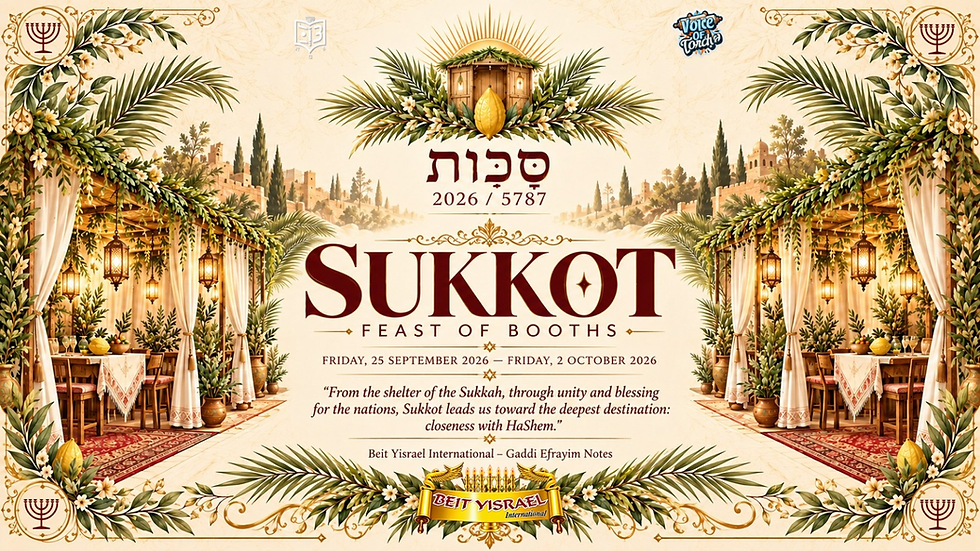
Sukkot for Hebrew Year 5787 begins at sundown on Friday, 25 September 2026 and ends at nightfall on Friday, 2 October 2026.
“Gaddi’s Notes on the Eternal Wisdom of the Prominent Sages”:
The Sukkah of Peace: Israel, the Nations, and the Messianic Future
Sukkot is Israel's universal festival. The seventy bulls offered during the seven days of Sukkot correspond, according to the Sages, to the seventy nations of the world and were offered for their atonement and the hastening of world peace.
The prophet Zechariah then projects this Temple reality into the Messianic future: the nations themselves will ascend to Jerusalem year after year to celebrate Sukkot and bow before the King of the universe.
The festival therefore moves from Israel's prayer for the nations to the nations' recognition of God, from the seventy nations to the unity of Divine kingship, and from the fragile Sukkah to the prophetic vision of a world sheltered beneath the Sukkah of peace.
A Prophetic Vision of Universal Redemption in Jewish Tradition
Sukkot contains one of the most remarkable universal dimensions in the Jewish calendar. Although it is a distinctly Jewish festival, the biblical sacrifices, prophetic readings, rabbinic teachings and later mystical tradition connect Sukkot directly with the nations of the world, universal peace, rain, Divine kingship and the Messianic future.
The central idea is striking:
During Sukkot, Israel does not pray only for itself. Israel brings offerings on behalf of the seventy nations.
This becomes the foundation for a larger prophetic vision: the restoration of Jerusalem, the revelation of God's kingship, the gathering of the nations and the emergence of an era of universal peace.
1. The mystery of the seventy bulls
The Torah commands an unusual number of bulls during Sukkot:13 + 12 + 11 + 10 + 9 + 8 + 7 = 70 bulls.
The Talmud asks why.
Rabbi Elazar answers:
“These seventy bulls correspond to the seventy nations.”
The Gemara then explains that the offerings are associated with atonement for the nations of the world.
This is an extraordinary theological idea.
Israel is celebrating its own festival, yet the Temple service includes a spiritual responsibility for the entire human family.
Sukkot therefore has two dimensions:
Israel's covenant with GodandIsrael's responsibility toward humanity.
The holiday is simultaneously particular and universal.
2. Who are the “seventy nations”?
The concept of seventy nations is rooted in the biblical Table of Nations in Genesis 10.
The number seventy becomes a symbolic representation of the totality of humanity. Later Jewish tradition develops the idea of the “seventy nations” as representing the nations of the world.
This is important because the rabbinic teaching isn't necessarily saying that the ancient world consisted of precisely the same political nations we recognize today.
Rather:
Seventy represents the fullness of the nations.
So when Sukkot brings seventy bulls, the symbolism is comprehensive:No nation is outside the horizon of Divine concern.
3. Israel's Temple service becomes a prayer for humanity
The Midrash Tanchuma makes the universal dimension even clearer.
It teaches that during Sukkot Israel offered seventy bulls for the seventy nations.
The meaning is profound.
Israel's worship was never intended to be merely:
“God, bless us.”
It also contained:
“God, bless the world.”
This makes Sukkot one of the clearest biblical/rabbinic expressions of the Jewish idea that Israel's election carries responsibility, not merely privilege.
4. Rabbi Yochanan's astonishing statement
The Talmud then says something particularly powerful.
Rabbi Yochanan declares:
“Woe to the nations of the world that lost something and do not know what they lost.”
Why?
Because while the Temple stood, the seventy bulls offered during Sukkot provided atonement for the nations.
The nations themselves may not have understood what was taking place.
Israel was serving before God on behalf of the wider world.
This creates a remarkable theological picture:
The Jewish Temple was not merely a Jewish institution. Its spiritual service had universal significance.
The Temple was envisioned as a place through which blessing could flow outward to humanity.
5. Why Sukkot is connected with rain
Here we reach another major prophetic dimension.
Sukkot occurs at the beginning of the rainy season in the Land of Israel.
Rabbinic tradition teaches that on Sukkot the world is judged concerning water.
Rashi therefore connects the seventy bulls with atonement for the nations so that rain may come upon the entire world.
This is extraordinarily significant.
Rain does not recognize political borders.
If God sends rain, it sustains:
Israel,
the nations,
agriculture,
animals,
forests,
rivers,
the entire living world.
Therefore the Sukkot service becomes an image of universal Divine providence.
6. Water becomes a symbol of universal blessing
Jewish tradition repeatedly connects water with:Torah, life, blessing and Divine abundance.
The Talmud even teaches that the day of rain is comparable to the day on which Torah was given, and in one statement says that rain is greater than the day Torah was given because Torah itself is compared to rain.
This gives Sukkot a remarkable symbolic structure:Sukkot → water → rain → life → nations → universal blessing.
The festival therefore points beyond Israel toward the renewal of creation itself.
7. Zechariah 14: Sukkot becomes a Messianic festival
The most explicit prophetic connection between Sukkot and the Messianic age appears in Zechariah 14.
The prophet describes a future time when God becomes King over the entire earth:
“And the LORD shall be King over all the earth; in that day there shall be one LORD and His name one.”— Zechariah 14:9
Then, remarkably, the prophecy immediately speaks about Sukkot.
The nations are described as coming to Jerusalem to worship the King and celebrate the Feast of Booths.
This establishes an extraordinary prophetic equation:Messianic age → Jerusalem → Divine kingship → nations → Sukkot.
Sukkot is therefore not merely a memorial of the past.It becomes a prophetic picture of the future.
8. The nations will come to Jerusalem
Zechariah's vision is not that the nations disappear.It is that the nations turn toward God.
This distinction is crucial.
The prophetic vision is not necessarily:
“Everyone becomes identical.”
Rather:
Humanity comes into recognition of one Divine sovereignty.
The nations retain their identity, but their relationship to God changes.
This is consistent with the broader prophetic vision of the Messianic era:many peoples → one God → universal justice → peace.
9. “One God and His Name One”
Zechariah's phrase is among the great Messianic declarations of Tanakh:
“On that day the LORD shall be One and His Name One.”
The Jewish sages and liturgy understood this as a vision of the ultimate revelation of Divine unity.
The Messianic age therefore is not fundamentally about political domination.It is about revelation.
The world comes to recognize what was always true:
There is one Creator, one source of life and one ultimate sovereignty.
Sukkot becomes the festival through which that universal future is symbolically anticipated.
10. Why the nations are judged through Sukkot
Zechariah then says that nations who refuse to go up to Jerusalem for Sukkot will receive no rain.
This creates an extraordinary relationship:Sukkot → rain → nations → Divine sovereignty.
The prophetic message is not simply:
“Come celebrate our holiday.”
It is:
Recognize the source of life.
Rain is used as the prophetic language of dependence.
Human civilization ultimately depends upon something it cannot manufacture.
The nations must recognize that life itself comes from God.
11. The seventy nations and the one nation
Now we encounter one of the most beautiful teachings of Sukkah 55b.
During the seven days of Sukkot:70 bulls → 70 nations.
On Shemini Atzeret :1 bull → Israel.
Rabbi Elazar explains the difference through the parable of a king who hosts a great banquet for everyone and then, after the guests leave, asks his beloved companion to remain for one more intimate meal.
This creates a movement:
Sukkot
Universal humanity
↓
Shemini Atzeret
Israel's intimate covenant with God
The two are not opposites.
The universal dimension comes first, and then Israel's unique covenantal intimacy is emphasized.
The universal dimension comes first, and then Israel's unique covenantal intimacy is emphasized.
12. The deeper Messianic pattern
This can be read prophetically as:Israel's calling is universal in purpose, even though its covenant remains particular.
Israel is not chosen instead of humanity.Israel is chosen for the sake of a Divine mission within humanity.
The seventy bulls embody this responsibility.
The Jewish people stand before God and carry the nations within their prayer.
This is consistent with the prophetic calling of Abraham:
“Through you all the families of the earth shall bless themselves.”
The election of Israel ultimately points outward.
13. Sukkot and the Abrahamic promise
Abraham is the first of the traditional Ushpizin.
His defining attribute is Chesed — loving-kindness.
Abraham's tent is open in every direction.
He welcomes guests.
This is deeply compatible with Sukkot.
The Sukkah itself has an open, welcoming character.
And the first Ushpizin represents the opening of the covenantal story toward the nations.
Thus we can see:Abraham → hospitality → Israel → Temple → Sukkot → seventy nations → Messianic peace.
The universal horizon was already present in Abraham's calling.
14. The Zohar and the Ushpizin
The mystical tradition of the Zohar identifies seven spiritual guests associated with Sukkot:
Abraham
Isaac
Jacob
Moses
Aaron
Joseph
David
They are known as the Ushpizin, the “holy guests.”
The Zoharic tradition connects entering the Sukkah with receiving the Shekhinah, the Divine Presence, and associates the seven shepherds with the Sukkah.
The sequence ends with David.
This is particularly significant for your earlier theme of Sukkah David HaNofelet.
David represents Malchut — kingship, the final manifestation of Divine sovereignty.
Therefore the Sukkah contains both:the spiritual ancestors of Israelandthe future revelation of Divine kingship.
15. David, Sukkot and the Messianic kingdom
David's significance becomes even greater when we place him beside Zechariah.
Amos says:
“I will raise up the fallen Sukkah of David.”
Zechariah says:
“The LORD shall be King over all the earth.”
And Zechariah connects that future with Sukkot.
These prophecies can therefore be read together:Davidic restoration → Divine kingship → Jerusalem → nations → Sukkot → universal recognition of God.
The restored Davidic kingdom is therefore not an end in itself.
It becomes an instrument for the revelation of Malchut Shamayim — the Kingship of Heaven.
16. The Messianic era is not merely “Israel's victory”
This is an important distinction for a serious Jewish article.
The prophetic Messianic vision should not be reduced to:
“Israel defeats the nations.”
The larger prophetic picture is:
The nations themselves are transformed in their relationship to God.
Isaiah speaks of nations streaming toward Jerusalem.
Micah envisions peoples saying:
“Come, let us go up to the mountain of the LORD.”
And Zechariah specifically places the nations' pilgrimage within Sukkot.
The end of history is therefore portrayed as recognition, worship, justice and peace, rather than merely political conquest.
17. Sukkot as a rehearsal for the Messianic world
This gives Sukkot a unique spiritual function.
For seven days, the Jew lives outside the illusion of permanent security.
The walls are temporary.
The roof is open.
The world outside remains visible.
And yet the person experiences joy.
This becomes an image of the Messianic consciousness:
The world is no longer built upon human self-sufficiency but upon recognition of Divine sovereignty.
The Sukkah is therefore a miniature prophetic world.
18. “Sukkah of Peace”
There is also the beautiful liturgical expression:"Peace be upon us."
“Who spreads over us the Sukkah of peace.”
This can be read alongside Zechariah's Messianic vision.
The final Sukkah is not merely a shelter from physical danger.
It symbolizes a world sheltered under Shalom.
Therefore:Sukkah → Divine protection → peace → nations → Messianic kingdom.
19. The seventy nations are included in Israel's joy
There is an important ethical dimension here.
The rabbis do not say:
“Israel offers seventy bulls because the nations are irrelevant.”
They say the opposite.
Israel's Temple service is somehow carrying the welfare of the nations before God.
The Midrash Tanchuma even describes Israel saying:
“We are offering seventy bulls for the seventy nations.”
That is a remarkable spiritual responsibility.
Israel's worship has consequences beyond Israel.
20. Sukkot and universal responsibility
The theological principle can therefore be expressed:
Covenant creates responsibility.
Israel receives Torah.
Israel receives the Temple service.
Israel receives Sukkot.
But the blessing does not stop at Israel.
It flows outward.
The seventy bulls become a ritual symbol of:“We stand before God with the nations in our consciousness.”
21. The Temple as the center of universal blessing
The prophets repeatedly envision Jerusalem as the center from which Divine knowledge and blessing spread outward.
Sukkot gives this prophetic vision a concrete ritual form.
The Temple becomes:Jerusalem → Israel → nations → creation.
This is why the destruction of the Temple has a universal dimension in the Talmud.
Rabbi Yochanan asks:
If the seventy bulls once atoned for the nations, who atones for them now?
The rabbis therefore understood the Temple's disappearance as affecting the spiritual welfare of the wider world.
22. The Messianic restoration reverses this
If the Temple's destruction interrupts this universal service, then the prophetic restoration reverses it.
Therefore:
Temple restored↓Sukkot service restored↓seventy nations represented↓rain and blessing↓nations recognize God↓Divine kingship revealed↓Messianic peace
This gives Sukkot a powerful place in Jewish eschatology.
23. The mystical dimension: from seventy to one
There is an even deeper pattern.
Sukkot begins with:70 nationsand concludes with:1 bull for Israel.
Zechariah ultimately says:“God is One and His Name One.”
So the movement can be understood mystically as:multiplicity → unity.
Not the destruction of diversity.
Rather:
Diversity discovers its common Divine source.
The seventy nations do not cease to exist.
They are brought into relationship with the One.
This is the Messianic idea of achdut — unity.
24. The seventy nations and the seventy faces of Torah
Jewish tradition also speaks about Torah having “seventy faces” (shiv'im panim laTorah).
The symbolism is intriguing:70 nations70 languages70 dimensions / faces of Torah
The world is diverse.
Humanity speaks many languages.
But Torah provides a Divine center capable of addressing the multiplicity of creation.
In the Messianic era, this diversity does not necessarily disappear.
It becomes harmonized around the knowledge of God.
25. The Messianic era as revelation of hidden unity
This is perhaps the most profound way to understand Zechariah 14.
The Messianic era is not God becoming One.
God is already One.
Rather:
Humanity finally perceives the One who has always been One.
The Hebrew phrase:And the Lord shall be king over all the earth
means:
“The LORD shall become King over all the earth.”
Not because God's sovereignty changes.
Because human recognition of that sovereignty changes.
26. The prophetic connection with Amos
Now connect Zechariah with Amos.
Amos 9
“I will raise the fallen Sukkah of David.”
Zechariah 14
“The LORD shall be King over all the earth.”
Zechariah 14
The nations shall come for Sukkot.
These three ideas belong together:Davidic restoration→Divine kingship→Nations→Sukkot→Messianic revelation.
This is the prophetic architecture of the festival.
27. The Sukkah becomes the image of the redeemed world
A Sukkah has:
a roof open toward heaven,
walls that create shelter,
an entrance,
hospitality,
temporary architecture,
Divine blessing.
These can become prophetic metaphors.
Open roof:Humanity turns toward Heaven.
Shelter:God's protection.
Entrance:The nations can come.
Hospitality:Abrahamic kindness.
Temporary structure:Human power is not ultimate.
Divine Presence:The world becomes a dwelling place.
Thus the Sukkah becomes a miniature picture of the Messianic world.
28. From Sukkot to the ultimate “Sukkah of David”
Now your previous theme of Sukkah David HaNofelet becomes essential.
The fallen Sukkah is not restored merely so that David can possess a throne.
It is restored so that Malchut can be revealed.
And when Malchut is revealed, the nations can recognize the One King.
Therefore:
The restoration of David's Sukkah has universal consequences.
It is Israel's restoration that becomes part of humanity's restoration.
29. A Chassidic reading of the Messianic Sukkah
From the perspective of Chassidic thought, one can describe the process as:
Galut — Exile↓Divine concealment↓Shekhinah in hiddenness↓Israel maintains emunah↓Sukkot reveals Divine shelter↓David / Malchut↓Restoration↓Mashiach↓Divine kingship revealed↓Nations recognize God↓Universal peace.
This should be presented as a Chassidic synthesis, rather than attributed as a single quotation from one rebbe.
30. The final prophetic image
The great Jewish prophetic vision is therefore not simply:
“Israel will survive.”
It is much larger:
Israel will be restored, Jerusalem will be restored, Divine kingship will be revealed, the nations will turn toward God, and the world will enter an era of peace and blessing.
Sukkot stands directly inside this prophetic vision.
That is why Zechariah 14, with its dramatic description of the nations coming to Jerusalem for Sukkot, became the traditional Haftarah for the first day of Sukkot.
Source | Central idea |
Leviticus 23:33–43 | Sukkot and dwelling in booths |
Numbers 29:12–34 | The 70 bulls during Sukkot |
Genesis 10 | The nations descending from Noah |
Amos 9:11–15 | Raising the fallen Sukkah of David |
Zechariah 14:1–21 | Nations, Jerusalem, Sukkot and Divine kingship |
Isaiah 2:2–4 | Nations streaming to Jerusalem and universal peace |
Micah 4:1–4 | Messianic peace among the nations |
Sukkah 55b | 70 bulls = 70 nations; one bull = Israel |
Midrash Tanchuma, Pinchas 16 | Israel offers for the 70 nations |
Bamidbar Rabbah 21:24 | The banquet analogy of Sukkot/Shemini Atzeret |
Zohar, Emor / Sukkot passages | Ushpizin and Divine Presence |
Maharal, Netzach Yisrael 35 | The fallen Sukkah of David and restoration |
Sefat Emet, Sukkot | Temporary dwelling, faith and Divine attachment |
Rashi on Sukkah 55b / Numbers 29 | Offerings and rain for the nations |
The central Talmudic source is especially important: Sukkah 55b explicitly connects the seventy bulls to the seventy nations and describes them as serving their atonement; it then contrasts them with the single bull of Shemini Atzeret for Israel.
Conclusion:
Sukkot is the Jewish festival in which the destiny of Israel and the destiny of the nations meet. The Torah's seventy bulls, according to the sages, correspond to the seventy nations of the world; the Temple service therefore embraced humanity in prayer and atonement. The prophets carry this universal dimension into the Messianic future: Zechariah envisions the nations coming to Jerusalem for Sukkot, while proclaiming that the LORD will become King over all the earth. Read alongside Amos's promise to raise the fallen Sukkah of David, Sukkot becomes a prophetic image of restoration—the restoration of Israel, the revelation of Divine kingship, the gathering of the nations and the emergence of universal peace.
The deepest message
Sukkot begins with seventy nations and ends with One.
Not one nation replacing seventy, but seventy nations discovering the One God.
That is the prophetic heart of Sukkot:
From the seventy nations → to the One King → to one world under Divine peace.
And this is why the Messianic vision of Zechariah is so naturally connected with Sukkot: the final redemption is envisioned not merely as Israel's restoration, but as the restoration of humanity's relationship with the Creator.
Gaddi Efrayim Notes: Israel as a vessel for the nations
His notes describe Israel's election not primarily as a worldly privilege but as a Divine mission:
Israel carries Torah from Sinai toward the nations.
His formulation is essentially:Israel is the vessel.Torah is the light.The nations are the wider field of Divine purpose.
His Shavuot notes describe Israel as a bridge through which the light of Torah moves from revelation into the life of humanity.
Applied to Sukkot, this gives a powerful interpretation of the seventy bulls:
Israel's covenantal worship carries the nations before God.
One of the strongest images in Gaddi Efrayim's Sukkot-related notes concerns Gog u'Magog.
His interpretation contrasts:the closed roof of human powerwiththe open roof of the Sukkah.
In his formulation:
“Gog's ‘roof’ of self-reliance will collapse before the Sukkah's openness to Heaven.”
This is a contemporary interpretive image rather than a quotation from an ancient sage.
But it connects naturally with the prophetic structure of Zechariah 14.
The nations initially come against Jerusalem.
Then the survivors come to Jerusalem to celebrate Sukkot.
Thus:war → recognition → worship → Sukkot → peace.
Gaddi's Efrayim Notes of Sukkot material explicitly speaks of the Light of Mashiach and the coming Geulah.
In another Beit Yisrael teaching, he describes Mashiach as the force that gathers the dispersed “rays” of humanity back toward their single Divine source.
This gives us a useful synthesis:
The seventy nations
represent humanity in multiplicity.
The seventy bulls
represent Israel's spiritual concern for that humanity.
The Sukkah
represents Divine shelter.
Mashiach
represents the revelation of Divine kingship.
Jerusalem
becomes the prophetic center.
The nations
turn toward the One God.
The result
is Shalom .
A synthesis of the sages and Gaddi Efrayim
Tanakh
Amos and Zechariah provide the prophetic framework:David restored → God King → nations → Sukkot → redemption.
Talmud
Sukkah 55b gives the extraordinary teaching:70 bulls = 70 nations.
Midrash
Midrash Tanchuma develops the idea of Israel's offerings on behalf of the nations.
Zohar
The Sukkah becomes a place of Shekhinah and the dwelling of the Ushpizin.
Maharal
The fallen Sukkah of David remains capable of restoration because its essential identity survives its fall.
Chassidut
The Sukkah becomes a symbol of:emunah, humility, Divine shelter, Divine Presence and redemption.


Comments