


Parashat Ki Teitzei 5786-22 August 2026 / 9 Elul 5786

“Gaddi’s Notes on the Eternal Wisdom of the Prominent Sages”:
Ki Teitzei: When You Go Out to Battle, Conquer the Heart First
Shiluach HaKen — Sending Away the Mother Bird
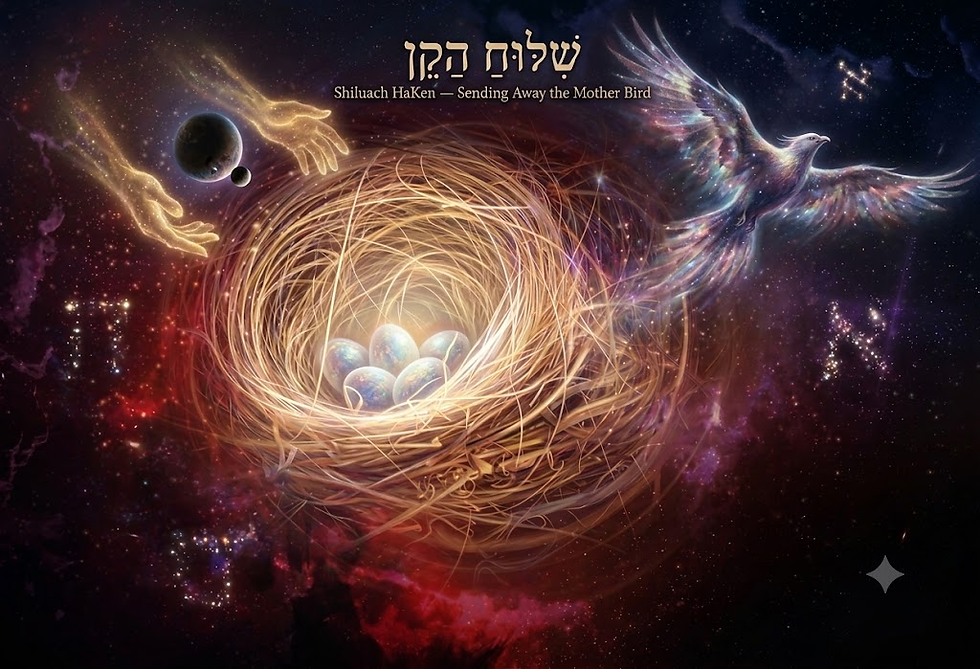
Deuteronomy 22:6–7: Compassion, Restraint, Creation, and the Mystery of Long Life
The mitzvah of Shiluach HaKen שִׁלּוּחַ הַקֵּן appears, at first glance, to be one of the simplest commandments in the Torah. If a person encounters a mother bird sitting over her eggs or young, the Torah forbids taking the mother together with her offspring. The mother must first be sent away.
Yet the Torah attaches an extraordinary promise:
“That it may be well with you, and that you may prolong your days.”
The Sages therefore saw this apparently small mitzvah as a window into some of Torah’s deepest themes: compassion, restraint, the preservation of creation, reward and the World to Come, and the transformation of the human heart.
1. A “Light” Mitzvah with an Enormous Reward
Rashi, following the Sages, observes that sending away the mother bird is regarded as an unusually easy mitzvah—one involving little difficulty or financial sacrifice—yet the Torah promises both goodness and length of days. The implication is a kal va-chomer: if such reward is associated with a seemingly light commandment, how much more must there be reward for difficult mitzvot faithfully performed.
This directly reflects the principle of Pirkei Avot 2:1:
Do not calculate the importance of a mitzvah merely by how easy or difficult it appears.
Human beings see the outward action.
Hashem sees:
obedience,
intention,
restraint,
transformation,
and the spiritual consequences flowing from the deed.
The smallest mitzvah may therefore touch realities far greater than the person performing it realizes.
Deep principle
There are no insignificant acts of obedience before Hashem.
2. Why Is the Reward Similar to Honoring Parents?
The Torah promises long life in connection with both:Kibbud Av va'Em — honoring father and mother,andShiluach HaKen — sending away the mother bird.
The pairing attracted considerable rabbinic attention.
One commandment concerns our relationship with the parents who gave us life.
The other concerns our treatment of a mother who is sustaining new life.
Both therefore center around:
respect for the continuity of life.
The Maharal develops this idea by associating these mitzvot with the preservation and continuation of existence.
The mother bird represents the reproductive source of the next generation. By releasing her, one does not destroy both present offspring and future reproductive potential.
So measure corresponds to measure:
When you preserve continuity, Torah associates the act with continuity of life.
The reward of arichut yamim—length of days—is therefore deeply appropriate.
3. Ramban — The Torah Is Training the Human Heart
Ramban gives one of the most important explanations of the mitzvah.
He connects Shiluach HaKen with the commandment:“An ox or sheep—you shall not slaughter it and its offspring on the same day.”
Ramban explains that these mitzvot teach us not to develop a cruel heart. He also suggests that taking parent and offspring together resembles destroying the continuity of an entire species.
This gives us a major Torah principle:
The commandments do not merely regulate behavior; they shape character.
A person repeatedly practicing cruelty gradually becomes cruel.
A person repeatedly practicing restraint and compassion becomes more compassionate.
Torah therefore intervenes even in apparently small situations.
A bird is ownerless.
No human being appears to be watching.
Legally, the person could imagine:
“Why should I restrain myself?”
And precisely there Torah answers:
Because your soul is being formed by what you do when nobody else has a claim over you.
4. Rambam — Animals Experience the Pain of Separation
Rambam gives a strikingly psychological explanation.
In Guide for the Perplexed III:48, he argues that the emotional attachment between mother and offspring exists among animals as well as humans. The purpose is therefore to prevent unnecessary suffering by ensuring that the mother does not witness the taking of her young.
Rambam then draws an ethical inference:
If Torah demands sensitivity even toward the suffering of animals, how much more carefully must we avoid causing suffering to human beings.
This transforms Shiluach HaKen into an ethical training ground.
The bird becomes our teacher.
The mitzvah asks:
Can you recognize suffering even when the sufferer cannot speak your language?
If so, perhaps you will become even more sensitive toward the pain of:the widow,the orphan,the stranger,the poor,the employee,the elderly,and the forgotten.
5. Sforno — Compassion for the Whole of Creation
Sforno emphasizes another dimension.
The wild birds are essentially ownerless, so no individual person can claim injury if someone takes them. Yet Torah nevertheless commands restraint because preserving the mother contributes to the continuation of the species. Sforno describes this as a small act of gemilut chasadim—lovingkindness—with consequences extending beyond the individual.
This introduces an ecological dimension into Torah thought.
Creation does not belong to us merely because we have the power to take from it.
Human beings are not absolute owners.
We are stewards within the Creator's world.
The question is therefore not merely:
“Am I permitted to take this?”
The deeper question is:
“What happens to creation if everyone takes everything merely because they can?”
6. The Power of Restraint
The extraordinary feature of Shiluach HaKen is that the person encounters something that is:available,ownerless,accessible,and apparently permissible.
Yet Torah says:Stop.
Send away the mother first.
This is one of the deepest disciplines Torah teaches.
Holiness often begins not with acquiring something but with refusing to take everything available to us.
The Torah repeatedly trains Israel in restraint:You may eat—but not everything.You may work—but not every day.You may harvest—but not every corner.You may possess wealth—but not ignore the poor.You may take the offspring—but not the mother sitting upon them.
Kedushah means:
I possess the power to take, yet I choose limits because Hashem commanded limits.
7. Berakhot 33b — Is the Mitzvah Really About Mercy?
Here Jewish thought introduces a fascinating tension.
The Mishnah teaches that if a person says in prayer, in effect, “Just as Your mercy reaches the bird's nest, have mercy upon us,” he is silenced. The Gemara records an explanation that such language wrongly reduces the Divine commandments to expressions of mercy when they must also be received as Divine decrees—gezerot.
At first this seems to contradict Rambam and Ramban.
But the two perspectives can be held together.
The mitzvah certainly trains human beings toward compassion.
Yet we should not say:
“I completely understand why Hashem commanded it.”
The humanly perceived reason for a mitzvah is not necessarily the totality of the Divine reason.
This distinction is crucial.
Torah allows us to seek ta'amei ha-mitzvot—reasons and wisdom behind mitzvot.
But it does not allow us to make our understanding the condition of obedience.
We obey because Hashem commanded.
Then we seek wisdom within the command.
8. Compassion and Divine Command Are Not Opposites
Ramban explicitly discusses the Berakhot passage and maintains that mitzvot can contain intelligible purposes—especially purposes that refine human beings—even though Hashem Himself needs nothing from our actions.
This produces a beautiful synthesis:
Hashem does not need the bird.
The bird may benefit from the command.
Creation may benefit from the command.
But ultimately:
we are the ones being transformed by the command.
The mitzvot refine those who perform them.
9. Why “It Will Be Good for You”?
Sforno connects the reward language with the principle that even a small act of lovingkindness produces fruit in this world while its ultimate spiritual reward remains beyond it.
The Torah says:
For the sake of your good.
— “that it may be good for you.”
This can be read at several levels.
It is good for:the bird, because the mother survives.creation, because continuity is preserved.society, because compassionate individuals create compassionate communities.your character, because restraint weakens cruelty.your soul, because obedience joins the person to the Divine will.
When we protect life, something within our own life becomes healthier.
10. “You Will Prolong Your Days” — The World to Come
The Talmud confronts a difficult question.
What if someone performs precisely those commandments for which the Torah promises long life—and then dies?
Chullin 142a records Rabbi Yaakov's teaching that the Torah's language concerning “good” and “long life” ultimately points beyond immediate earthly longevity toward:
the world that is entirely good
and
the world that is entirely long—
Olam HaBa, the World to Come.
This is crucial.
Torah is not offering a simplistic transactional formula:
Do mitzvah → automatically receive more biological years.
Rather, obedience connects a person to a form of life greater than temporary existence.
True arichut yamim ultimately means participation in enduring life.
11. The Tragedy of Elisha ben Avuyah
The Talmud attaches this very mitzvah to one of its most sobering theological stories.
According to one tradition, Elisha ben Avuyah witnessed a child obey his father by climbing up to fulfill Shiluach HaKen—thus apparently fulfilling both commandments associated with length of days—and yet the child fell and died.
The Gemara explains that had Elisha interpreted the promised reward as Rabbi Yaakov did—ultimately in relation to the World to Come—his theological crisis might have unfolded differently.
This teaches us that mitzvah cannot always be evaluated by immediate outcomes.
Faithfulness does not mean:
“I obey, therefore Hashem must give me the earthly outcome I expect.”
Rather:
I obey because the covenant is true even when I cannot presently see the complete accounting of Divine justice.
12. The Mother Bird as the Image of Rachamim
In Hebrew, rachamim—compassion is linguistically associated with rechem, the womb.
The mother protecting her offspring naturally becomes a powerful symbol of nurturing compassion.
The mitzvah confronts a person with maternal vulnerability at the precise moment he possesses power.
The mother remains over the nest because her instinct is to protect her young.
Her devotion makes her vulnerable.
Torah therefore prevents the human being from exploiting maternal love as a trap.
That itself contains a tremendous moral lesson:
Never exploit another person's love, loyalty, innocence, or vulnerability for your own advantage.
13. Kabbalistic Dimension — Awakening Mercy Above
Some later mystical interpretations move in another direction.
The distress and departure of the mother bird become part of a symbolic awakening of Divine compassion. Sources preserved in the Jewish mystical tradition describe the mother bird's cry as arousing heavenly mercy, ultimately invoking compassion upon creation.
Within this symbolic reading, the nest becomes more than a physical nest.
It can represent:the world,Israel,the Divine Presence,exile,and children separated from their source.
The mother searching for her children becomes an image of cosmic separation.
Thus the mitzvah becomes connected with galut and geulah—exile and redemption.
14. The Nest as the World
The Hebrew word:
nest
— ken — nest
suggests a dwelling, a place where life is nurtured.
A nest is fragile.
It can be destroyed in seconds.
Yet inside that fragile structure lies the possibility of future generations.
This is much like creation itself.
Humanity lives inside a world that appears abundant but is also vulnerable.
Shiluach HaKen therefore teaches:
Do not destroy the source while consuming the fruit.
This principle reaches far beyond birds.
It applies to:land,water,forests,animals,families,communities,economies,and future generations.
15. Shiluach HaKen and Honoring Parents
Now the parallel becomes even more beautiful.
In Kibbud Av va'Em, the child honors the source from which his own life came.
In Shiluach HaKen, the human being preserves the maternal source from which future life can continue.
Both mitzvot teach:
Honor the source of life.
Do not sever yourself arrogantly from what came before you.
And do not destroy what must continue after you.
This is why the promise of long life fits both commandments so powerfully.
16. “If It Happens Before You” — The Mitzvah Appears Along the Way
The Torah says:
"What is the meaning of the word 'Tzippor'?"
“If a bird's nest happens before you on the way…”
Rashi emphasizes that this describes a nest encountered incidentally rather than one already prepared or owned by the person.
Spiritually, this language is striking.
Many of life's greatest mitzvah opportunities appear:
baderekh — along the way.
You did not schedule them.
You simply encountered:someone needing help,something lost,a vulnerable animal,a person needing encouragement,an injustice requiring action.
Torah spirituality means becoming alert to holiness along the road.
17. The Mitzvah You Did Not Plan May Reveal Your Character
There is a difference between planned righteousness and spontaneous righteousness.
If we know beforehand that people are watching us, we prepare ourselves.
But what does it mean:
you suddenly encounter the situation.
There is no audience.No ceremony.No public recognition.
Just:you,the bird,the nest,and Hashem's command.
That moment reveals something important.
Who are you when holiness unexpectedly crosses your path?
Beit Yisrael International — Gaddi Efrayim Notes
1. The Nest Represents the Vulnerability of Creation
Shiluach HaKen reveals that Hashem cares about what human beings do even with something as small and apparently insignificant as a bird's nest.
If Torah concerns itself with a mother bird and her young, then surely humanity must learn not to treat creation merely as raw material for consumption.
The earth belongs to Hashem; humanity is a steward, not an absolute owner.
2. Power Must Always Be Controlled by Torah
The person standing before the nest possesses overwhelming power.The bird cannot enforce its rights.There is no owner demanding compensation.
Yet Torah says:restrain yourself.
This is genuine righteousness.
Anyone can behave ethically when threatened with punishment. Torah asks whether we remain righteous when we possess the power to take and nobody can stop us.
3. Compassion Begins Where Legal Ownership Ends
The nest is hefker—ownerless. That means the Torah is teaching something deeper than property law.
We may have the legal ability to acquire something and still be commanded to restrain ourselves.
“I have a right to do it” is not always the final Torah question.
We must also ask:Is it compassionate?Is it responsible?Does it preserve life?Does it reflect Hashem's holiness?
4. Do Not Destroy Tomorrow for Today's Appetite
The mother bird represents future continuity. Taking everything means consuming not only today's resource but potentially tomorrow's source.
This applies spiritually and materially.
A generation can consume:wealth,resources,institutions,traditions,Torah knowledge,and family structures—without leaving anything for those who follow.
Take what you need without destroying the source from which tomorrow must come.
5. The Smallest Mitzvah Reveals the Greatness of Obedience
The Torah attaches extraordinary reward to what appears to be a tiny commandment. This destroys our human tendency to divide Torah into:“important commandments”and“unimportant commandments.”
We do not know the true spiritual weight of a mitzvah. Therefore, every mitzvah deserves reverence.
6. Mercy Must Become Character, Not Sentiment
Ramban teaches that mitzvot prevent the development of cruelty.
This means compassion is not simply an emotion. Torah turns compassion into practice.
Send the mother.Return the lost object.Pay the worker.Leave produce for the poor.Do not muzzle the ox.Build the parapet.
These repeated acts slowly construct a compassionate human being.
Torah transforms rachamim from feeling into covenantal behavior.
7. The Mother Bird and the Scattered Children
In a deeper symbolic reading, the mother separated from her children can remind us of the pain of exile and scattering.
Israel itself has experienced dispersion.Families have been separated.Tribes have been scattered.Souls have become distant from their heritage.
Therefore, the image of the mother and children may awaken within us the longing for ingathering, restoration, and geulah.
Our calling should never be to exploit scattered people. It is to help restore them with:truth,Torah,compassion,patience,and faithfulness to Hashem.
8. “Baderekh” — Hashem Places Mitzvot Along Our Journey
The nest appears on the way. Likewise, Divine opportunities appear during life's journey.
Sometimes we ask:“Where is my mission?”
But perhaps Hashem has already placed it baderekh:in the person we meet,the suffering we notice,the responsibility we did not expect,or the life we have the ability to protect.
The righteous person develops eyes capable of recognizing these encounters.
9. Preserving the Nest Means Preserving the Future
A nest is small, but generations come from it. Likewise, a Torah home may look small in the eyes of the world.
Yet from that home may emerge:children,disciples,teachers,communities,and generations of faithfulness.
Protect the nest.
Protect Torah education.Protect families.Protect righteous community.Protect the transmission of Torah from generation to generation.
Central Spiritual Message
Shiluach HaKen teaches us that great holiness can be hidden inside very small actions.
A person walking down the road encounters a nest.Nobody is watching.The birds belong to nobody.Taking everything would be easy.
But Hashem says:
“Send the mother away.”
And in that tiny moment, enormous spiritual questions appear:Will power become exploitation or restraint?Will ownership become consumption or stewardship?Will desire become cruelty or compassion?Will we think only of today, or preserve tomorrow?Will we obey Hashem only when a command appears great—or also when it appears small?
That is why this seemingly simple mitzvah carries the language of extraordinary blessing:
“That it may be well with you, and that you may prolong your days.”
Because the person who learns to preserve life, restrain power, honor creation, and obey Hashem even in hidden moments is being formed into a person capable of true life—חיים, chayim—not only in this world, but ultimately in the world that is entirely good and entirely long.
Shiluach HaKen therefore teaches:
Do not measure a mitzvah by its size.
Measure it by the One who commanded it—and by the kind of person it forms you to become.


Baruch HASHEM..
respect for the continuity of life.
The Maharal develops this idea by associating these mitzvot with the preservation and continuation of existence.
The mother bird represents the reproductive source of the next generation. By releasing her, one does not destroy both present offspring and future reproductive potential.
So measure corresponds to measure:
When you preserve continuity, Torah associates the act with continuity of life.
The reward of arichut yamim—length of days—is therefore deeply appropriate.
Wonderful explanations...
Shalom Yisrael.