


Parashat Achrei Mot-Kedoshim 5786 -“After The Death”


The Inner Structure of the Parsha
Parashat Achrei Mot–Kedoshim is not merely a collection of laws—it is a spiritual map of transformation, guiding the soul from:
Death → Life
Impurity → Purity
Separation → Holiness (Kedushah)
The sages reveal that these two portions are one continuous process:
Achrei Mot (“After the death”) → Confronting brokenness
Kedoshim (“You shall be holy”) → Revealing divine potential
🕯️ 1. “After the Death” — The Secret of Spiritual Descent
📖 Leviticus 16:1
“After the death of the two sons of Aaron…”
🔍 From the Zohar:
The death of Nadav and Avihu is not just tragedy—it represents:
Uncontrolled spiritual desire
A fire without proper vessels
🔍 Ramban (Nachmanides):
Their death teaches that:
Even holiness must be approached with boundaries and structure
💡 Gaddi Efraim Notes:
“Spiritual fire without discipline leads to collapse;
true closeness to the Divine requires balance.”
👉 Achrei Mot begins with broken vessels—to teach us how to rebuild them correctly.
🕊️ 2. Yom Kippur Service — The Inner Atonement of the Soul
📖 Leviticus 16 (Avodat Kohen Gadol)
The High Priest enters the Holy of Holies once a year.
🔍 From the Talmud:
This service atones for:
Individual sin
National impurity
🔍 Zoharic Teaching:
The Kohen Gadol represents:
The higher soul (neshamah)
Entering the innermost point of unity with God
💡 Gaddi Insight:
“Every person has a Holy of Holies within—the place untouched by sin.”
👉 Yom Kippur is not only a day—
it is a state of inner return (Teshuvah).
🐐 3. The Two Goats — The Mystery of Duality
📖 Leviticus 16:7–10
One goat → for Hashem
One goat → sent to Azazel
🔍 From the Midrash Rabbah:
These goats symbolize:
Good inclination (Yetzer Tov)
Evil inclination (Yetzer Hara)
🔍 Zohar:
Both goats are identical → teaching:
Good and evil come from the same root
The difference lies in direction and elevation
💡 Gaddi Efraim Notes:
“The purpose is not to destroy darkness,
but to redirect it toward holiness.”
🔥 4. Forbidden Relationships — Guarding the Foundation
📖 Leviticus 18
The Torah lists the laws of arayot (forbidden relationships).
🔍 From the Zohar:
These laws protect:
The Sefirah of Yesod (foundation of holiness)
The channel through which divine energy flows
🔍 Rambam:
These mitzvot preserve:
Moral structure
Social stability
💡 Gaddi Insight:
“When the foundation is corrupted, the entire structure collapses.”
🌍 5. “The Land Will Vomit You Out” — The Living Land
📖 Leviticus 18:28
🔍 Browse:
Eretz Yisrael is not like other lands—it is:
Spiritually sensitive
Directly connected to divine presence
🔍 Midrash:
The land reacts to sin like a body rejecting poison.
💡 Gaddi Efraim Notes:
“The land reflects the soul of its people.”
👉 Holiness allows dwelling
👉 Impurity causes exile
🌟 6. Kedoshim — The Call to Divine Living
📖 Leviticus 19:2
“You shall be holy, for I, Hashem your God, am holy.”
🔍 From the Sifra:
Holiness means:
Separation from sin
Elevation in action
🔍 Rashi:
“Separate yourselves from forbidden relationships.”
🔍 Baal Shem Tov (Chassidut):
Holiness is not withdrawal—it is:
“Finding God in every action”
💡 Gaddi Insight:
“Kedoshim is not a command—it is an identity.”
⚖️ 7. “Love Your Neighbor as Yourself” — The Heart of Torah
📖 Leviticus 19:18
🔍 From the Rabbi Akiva:
“This is a great principle of the Torah.”
🔍 Hillel the Elder:
“What is hateful to you, do not do to another.”
🔍 Chassidut:
Loving others reveals:
The unity of all souls
The presence of the Divine in every person
💡 Gaddi Efraim Notes:
“To love another is to recognize the same divine spark within them.”
🌿 8. Holiness in Daily Life
Kedoshim teaches that holiness is not only in the Temple:
Business honesty
Speech purity
Care for the poor
Respect for parents
Justice in society
🔍 Ramchal (Mesillat Yesharim):
Holiness is the highest level:
Transforming even mundane acts into divine service
💡 Gaddi Insight:
“The goal is not to escape the world,
but to elevate it.”
🔥 The Deeper Unified Message
Achrei Mot–Kedoshim reveals a profound journey:
Stage | Spiritual Meaning |
Death (Achrei Mot) | Awareness of brokenness |
Atonement (Yom Kippur) | Inner purification |
Separation (Arayot laws) | Guarding holiness |
My dear | Living divine life |
✨ Final Song of Ephraim Reflection
“After the fall comes the call.
After impurity comes purification.
After distance comes holiness.
Achrei Mot is the descent—Kedoshim is the ascent.”
“Parashat Achrei Mot–Kedoshim 5786: From Atonement to Holiness — The Soul’s Journey”
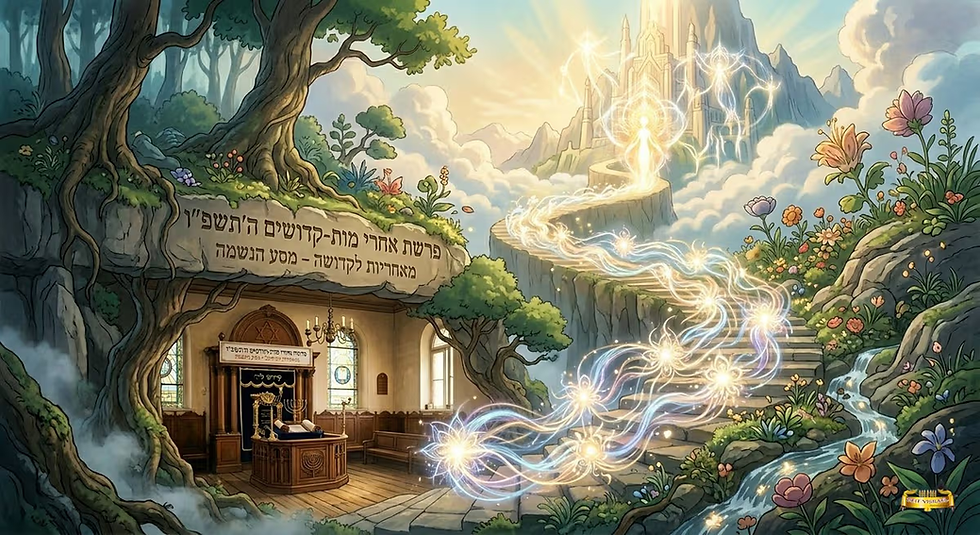
🔥 1. “After the Death” — The Beginning of Spiritual Life
Achrei Mot opens with the death of Nadav and Avihu, which the Zohar explains as a soul ascent beyond proper vessels.
Their “strange fire”represents unbalanced passion (Chesed without Gevurah).
True closeness to Hashem requires balance (Tiferet)—harmonizing love and restraint.
Gaddi Ephraim Notes:
“After the death” symbolizes the death of ego, not physical death.
Spiritual life begins when a person nullifies self-will for divine will.
🕊️ 2. Yom Kippur — Entering the Inner Holy of Holies
The High Priest’s service represents the soul entering its deepest essence (Yechidah) .
Midrash Rabbah teaches that Israel becomes like angels on Yom Kippur.
The two goats symbolize:
One for Hashem → Holiness and elevation
One for Azazel → Impurity and transformation
Gaddi Ephraim Notes:
The goats hint to Mashiach ben Yosef and Mashiach ben David .
Redemption comes through descent → transformation → ascent .
🏛️ 3. One Mishkan — The Secret of Spiritual Unity
The prohibition of outside sacrifices teaches centralized holiness .
Ramban : Serving outside the Mishkan = spiritual fragmentation .
Inner meaning:
A person must unify all aspects of life toward one divine purpose.
Gaddi Ephraim Notes:
The Mishkan represents the unified heart aligned with Hashem .
🩸 4. The Blood — Respecting the Divine Soul
“The blood is the soul” — life belongs to God .
Sefer HaChinuch : Avoiding blood trains reverence for life .
Inner teaching:
Elevate the animal soul , do not consume it in its raw state.
Gaddi Ephraim Notes:
This is the עבודה (labor) of refining inner desires into holiness.
⚖️ 5. Forbidden Relationships — Protecting Divine Image
These laws guard the sanctity of creation and the אדם.
Maharal of Prague : Improper relations distort the Tzelem Elokim .
Holiness requires:
Boundaries
Discipline
Sanctification of the physical
Gaddi Ephraim Notes:
Rectification of covenant is central to redemption.
✨ 6. “You Shall Be Holy” — The Call of Kedoshim
Kedoshim begins: Be holy — a universal call to holiness.
Rashi : Separation from immorality.
Ramban : Go beyond law—avoid being a “naval birshut haTorah.”
Holiness =
Sanctifying even what is permitted
Gaddi Ephraim Notes:
After removing impurity, one must actively fill life with divine light .
❤️ 7. Love Your Neighbor — The Foundation of Torah
And love your neighbor as yourself is the core of Torah.
Rabbi Akiva : This is the great principle of the Torah.
Zohar : All souls are one spiritual body .
Inner meaning:
Loving others = recognizing the same divine spark .
Gaddi Ephraim Notes:
Unity among ישראל is the vessel for Mashiach revelation.
🌍 8. Holiness in Everyday Life — Drawing Divine Light
Laws of Shabbat, charity, honesty = practical holiness.
Chassidut :
Holiness is not escape from the world
It is revealing God within the world
Every action becomes a channel for Shechinah .
Gaddi Ephraim Notes:
התורה transforms daily life into a dwelling place for the Divine.
🔄 9. The Complete Spiritual Process — From Removal to Revelation
Achrei Mot → Removal (Teshuvah)
Remove ego, impurity, fragmentation
Kedoshim → Revelation (Kedushah)
Live holiness in every detail
Spiritual equation:
Descent → Rectification → Holiness → Divine Presence
Gaddi Ephraim Notes:
This reflects the mission of Israel and the light of Mashiach :
To transform the world into a dwelling place for the Infinite .
🌟 Final Insight
Achrei Mot teaches how to empty the vessel .
Kedoshim teaches how to fill the vessel with divine light .
Together, they reveal the path from death → life , impurity → holiness , separation → unity with Hashem .



Comments