


Another Year has passed, and Israel needs the Torah more than ever.

Updated: Apr 30
Baruch Hashem
Date: April 21, 2026

A Covenant Nation Returning to Its Land
The return of the Jewish people to the Land of Israel after nearly two thousand years of exile is not a political accident or a historical coincidence.
According to the Torah and the Prophets, it is a covenantal process deeply tied to spiritual responsibility, national behavior, and alignment with divine instruction.
The Torah explicitly frames national presence in the land as conditional:
“If you walk in My statutes and keep My commandments… I will give peace in the land.”
(Leviticus 26:3–6)
And also warns with equal clarity:
“If you do not listen to Me… I will scatter you among the nations.”
(Leviticus 26:33)
These are not symbolic verses. They define a structural principle in Jewish thought: national stability is directly tied to moral and spiritual alignment.
Why Exile Happened: Not Just History, but Internal Collapse
The Prophets repeatedly explain that exile was not simply political defeat but internal spiritual disconnection.
Isaiah states clearly:
“This people draws near with their mouth and honors Me with lips, but their heart is far from Me.”
(Isaiah 29:13)
This describes a disconnect between external religious expression and internal truth. Jewish tradition understands exile as the consequence of this gap between action and heart.
The Talmud further deepens this understanding:
The First Temple was destroyed due to idolatry, immorality, and bloodshed
The Second Temple was destroyed due to baseless hatred
Exile, therefore, is not only punishment—it is correction.
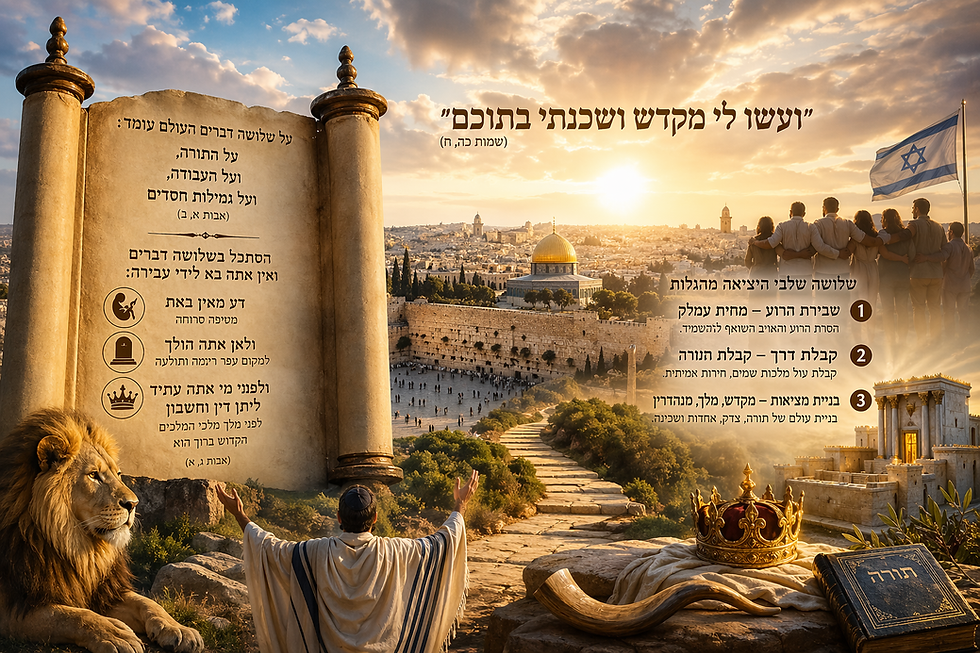
The Foundations of Reality According to Pirkei Avot
Jewish ethical teaching defines the structure of existence itself:
“The world stands on three things: on Torah, on divine service, and on acts of kindness.”
(Pirkei Avot 1:2)
These three pillars define stability:
Torah – objective divine truth and guidance
Divine service – inner connection and prayer
Kindness – ethical behavior between people
When these pillars weaken or are replaced by ideology alone, instability follows—personally and nationally.
The Core Awareness That Prevents Moral Collapse
Another foundational teaching states:
“Know from where you came, where you are going, and before whom you are destined to give account.”
(Pirkei Avot 3:1)
The Mishnah continues:
From a drop of physical origin
To dust and decomposition
And ultimately to judgment before God
This is not meant to diminish human dignity—it is meant to eliminate illusion.
A society that forgets origin and destiny loses moral clarity.
Exile and Return: Not Geography, but Transformation
Returning to the Land of Israel is not simply crossing borders or establishing sovereignty. It is a transition from exile consciousness to covenant consciousness.
Between Passover and Shavuot, Jews count the Omer—49 days of spiritual refinement. This period represents movement from liberation to responsibility.
Freedom in Torah is not escape from authority, but alignment with divine purpose.
“I am the Lord your God who brought you out of the land of Egypt, out of the house of bondage.”
(Exodus 20:2)
Freedom begins with recognition of divine direction.
The Structure of National Restoration
Maimonides outlines three mitzvot upon entering the Land:
Appointing a king
Eradicating Amalek
Building the Temple
These are not historical instructions alone—they define national structure.
1. Kingship
A king in Israel is not absolute ruler but servant of Torah:
“He shall write for himself a copy of this Torah… and read it all the days of his life.”
(Deuteronomy 17:18–19)
2. Amalek
Represents radical forces of destruction that oppose moral order.
3. The Temple
Represents unity of divine service and national spiritual center.
A Nation Not Meant to Be Like Others
The Torah repeatedly warns Israel not to imitate surrounding nations:
“You shall not follow their statutes.” (Leviticus 18:3)
“Do not learn their ways.” (Deuteronomy 18:9)
“You are a holy people to the Lord.” (Deuteronomy 7:6)
“I have separated you from the nations.” (Leviticus 20:26)
“Do not walk in their ways.” (Exodus 23:24)
The message is consistent: Israel’s identity is not imitation—it is mission.
Kingship and the Ultimate Goal of History
Jewish kings such as David and Solomon are not models of power, but models of submission to divine will.
The prophetic vision ultimately points beyond all human systems:
“The Lord will be King over all the earth; on that day the Lord will be One and His name One.”
(Zechariah 14:9)
And Maimonides describes the messianic era:
“The occupation of the entire world will be only to know the Lord.”
(Mishneh Torah, Hilchot Melachim 12:5)
The endpoint of history is not political dominance, but divine awareness.
Where We Stand Today
The return to the Land has begun—but completion has not yet arrived.
Jewish history is not finished. It is unfolding.
The counting of the Omer teaches that redemption is gradual, structured, and internal as much as external.
Every generation stands at a threshold:
Between survival and purpose
Between fragmentation and unity
Between imitation and covenant
Conclusion: A Nation in Process
The Jewish people are not a nation defined only by geography or politics, but by a covenant that spans history.
Returning to the land is only the beginning.
The deeper return is internal: return to Torah, return to clarity, return to unified purpose.
The question each generation must face is not only where history is going—but what role we choose to play within it.
The process is still unfolding.


Comments