


Parashat Beha'alotcha -"When You Raise-6 June 2026 / 21 Sivan 5786

Parashat Beha’alotekha : Raising the Hidden Flame of the Soul
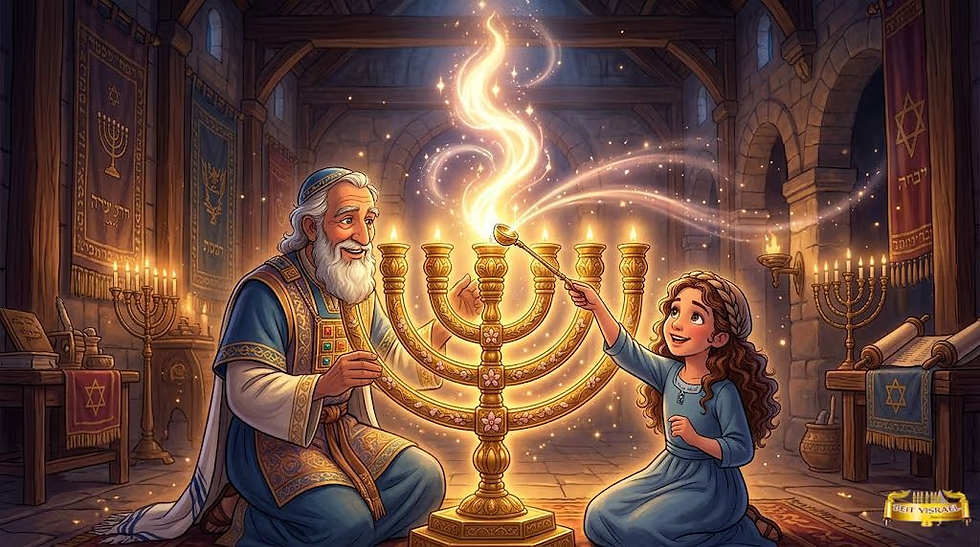
ParashatBeha’alotekha opens with the command toAharon:
“When you raise the lamps, the seven lamps shall give light toward the face of the Menorah.”
-Numbers 8:2
The Torah does not say“when you light” but“when you raise.”
Rashi, based on theSifrei, explains thatAharon had to kindle the flame until the flame rose by itself.
This becomes one of the deepest teachings of theparsha.
Truespiritual leadership is not merely to inspire people for a moment, but to raise theirinner flame until theirsoul can burn with its ownholy strength.
From the perspective of theJewish sages, theMenorah represents thesoul of Israel, thewisdom of Torah, and theDivine light that shines through theMishkan into the world.
✨ 1. The Menorah and the Seven Lights of the Soul
The Menorah had seven branches .
The sages connect this to theseven lower sefirot:Chesed,Gevurah,Tiferet,Netzach,Hod,Yesod, andMalchut.
Eachsoul has a differentspiritual path, a different“branch,” but all must face toward thecenter, toward theDivine Presence.
TheZohar teaches that theMenorah hints to the illumination of theupper wisdom flowing downward intocreation.
Thelamps are not simplyphysical lights; they arechannels ofspiritual consciousness.
Gaddi Ephraim Notes:
The task ofBeit Yisrael is like the task ofAharon HaKohen.
It is not only tospeak Torah, but to raise thelamp of everysoul.
Each person carries a hidden flame.
Some souls are dimmed by exile, confusion, pain, or distance from Torah, but the light is never destroyed.
The work of Torah is to awaken the inner flame until it rises by itself.
🎼 2. The Levites and the Secret of Spiritual Service
The Levites are inaugurated for service in the Mishkan.
They are separated, purified, and dedicated to carry the holy vessels.
The Midrash teaches that the Levites represent those who attach themselves fully to HaShem’s service.
Their role is not based on personal honor, but on carrying holiness for the entire nation.
The Rambam writes that not only the tribe of Levi, but any person whose spirit moves him to separate himself and stand before HaShem may become sanctified like the Holy of Holies in his inner life.
This means the “Levite” is also a spiritual archetype.
It represents the person who says:
My life is not only for survival, success, or personal desire. My life is for Divine service.
Gaddi Ephraim Notes:
In every generation, HaShem raises spiritual Levites, people whose mission is to carry the vessels of holiness.
Today those vessels may be Torah teaching, prayer, technology for holiness, education, translation, podcasts, and spreading the light of Mashiach to the scattered souls of Israel and the nations.
🚪 3. Pesach Sheni: The Power of a Second Chance
One of the most beautiful moments in Beha’alotekha is the story of people who were impure and unable to bring the Korban Pesach at the proper time.
They come to Moses and cry:
“Why should we be diminished?”
Numbers 9:7
This cry opens the door to Pesach Sheni, the Second Passover.
The sages explain that Pesach Sheni reveals that it is never too late.
Even if a person was distant, impure, delayed, or spiritually unprepared, HaShem opens another gate.
The Previous Lubavitcher Rebbe famously taught:
“The lesson of Pesach Sheni is that nothing is ever lost. It is never too late. One can always correct.”
This is a powerful principle of teshuvah.
The soul may miss its first opportunity, but the Creator of mercy opens another path.
Gaddi Ephraim Notes:
Pesach Sheni is the voice of the lost sheep of Israel.
It is the cry of souls who say,
“Why should we be left outside the covenant?”
The Torah answers: there is a second gate.
There is a path of return.
The mission of Beit Yisrael International is connected to this cry, to awaken those who were distant and bring them near to the light of Torah, holiness, and redemption.
🌵 4. The Complaints in the Wilderness: When Desire Darkens Vision
After the spiritual heights of the Menorah, the Levites, and Pesach Sheni, the parsha shifts to the complaints of Israel.
The people complain about hardship.
Then they crave meat and remember Egypt:
“We remember the fish that we ate in Egypt freely.”
Numbers 11:5
The sages ask: Was Egypt truly free?
Israel were slaves there.
The word “free” means free from mitzvot, free from spiritual responsibility.
This is the danger of exile consciousness.
A person can leave Egypt physically but still carry Egypt inside the mind.
The body may be free, but the desire can remain enslaved.
The Zohar explains that the wilderness journey is the purification of the soul.
Every complaint reveals a hidden impurity that must be corrected before entering the Land.
Gaddi Ephraim Notes:
The wilderness is the inner battlefield of the soul.
Egypt represents the old identity.
Sinai represents revelation.
The Land of Israel represents divine mission.
Between revelation and mission, the soul must pass through tests.
Complaints show where the soul has not yet fully trusted HaShem.
🐦 5. The Quail and the Danger of Unrefined Appetite
The people demand meat, and HaShem sends quail.
But the desire becomes destructive.
The Torah is not teaching that physical needs are evil.
Judaism does not reject the body.
Rather, the sages teach that desire must be elevated.
Food, wealth, speech, relationships, and success must all become vessels for serving HaShem.
When desire becomes disconnected from holiness, it becomes a force of spiritual downfall.
The manna represented faith, humility, and daily dependence on HaShem.
The craving for meat represented the demand for physical satisfaction without spiritual refinement.
Gaddi Ephraim Notes:
The generation of the wilderness received heavenly bread, but still desired the taste of Egypt.
This teaches that even after receiving Torah, a person must refine imagination, memory, appetite, and speech.
Redemption is not only leaving exile; it is removing exile from within the soul.
🕊️ 6. The Seventy Elders and the Expansion of Prophetic Spirit
Moses feels the burden of leading the people.
HaShem commands him to gather seventy elders, and He places some of Moses’ spirit upon them.
This reflects the structure of Israel as a prophetic nation.
The number seventy connects to the seventy souls who descended to Egypt, the seventy nations, and the seventy faces of Torah.
The sages teach that Torah leadership must be shared, transmitted, and expanded.
Moses remains the root, but the light spreads into many vessels.
Gaddi Ephraim Notes:
The seventy elders hint to the future mission of Torah reaching the seventy nations.
The light of Moses must not remain hidden in one place.
It must be distributed through many vessels, many languages, and many souls.
This is the inner mission of spreading Torah wisdom globally while remaining faithful to the source.
🌟 7. Eldad and Medad: Prophecy Beyond the Camp
Eldad and Medad prophesy in the camp.
Joshua is concerned, but Moses responds:
“Would that all HaShem’s people were prophets.”
Numbers 11:29
This is one of the most profound verses in the Torah.
Moses does not fear the spreading of spiritual light.
He desires that every soul become a vessel of Divine awareness.
The sages explain that true leadership is not jealous.
A true tzaddik wants others to rise.
Gaddi Ephraim Notes:
Moses reveals the heart of Mashiach consciousness.
The goal is not control, but illumination.
The Torah of redemption awakens prophecy, wisdom, and Divine consciousness in every soul.
The leader does not seek followers only; he seeks awakened servants of HaShem.
🗣️ 8. Miriam’s Speech and the Disease of Lashon Hara
At the end of the parsha, Miriam speaks about Moses and is struck with tzara’at.
The Torah shows how serious speech is.
Miriam was righteous, and her intention was not simple evil.
Yet even subtle speech against Moses carried spiritual consequence.
The sages teach that lashon hara damages three:
The speaker, the listener, and the one spoken about.
In mystical thought, speech is not merely sound.
Speech creates spiritual realities.
Moses is described as:
“Very humble, more than any person on the face of the earth.”
Numbers 12:3
His humility made him the greatest vessel for prophecy.
Because he was empty of ego, the Divine Presence could speak through him clearly.
Gaddi Ephraim Notes:
Miriam’s story teaches that the closer one is to holiness, the more refined speech must become.
In the work of redemption, speech must build, heal, and illuminate.
The Voice of Torah must avoid accusation and become a vessel of truth, humility, and restoration.
🔮 9. Moses: The Mirror of Clear Prophecy
HaShem explains that Moses’ prophecy is unique:
“With him I speak mouth to mouth, clearly, and not in riddles.”
Numbers 12:8
The sages describe Moses as seeing through a clear mirror, while other prophets see through an unclear mirror.
This does not mean Moses had imagination or mystical emotion only.
His prophecy was direct, purified, and completely aligned with Divine truth.
The secret is humility.
Moses did not block the Divine light with ego.
Gaddi Ephraim Notes:
The more a person removes self-centeredness, the clearer the Divine light becomes.
Moses is the model of the true servant.
His greatness is not that he lifted himself above others, but that he became transparent before HaShem.
✨ Core Spiritual Message of Beha’alotekha
Beha’alotekha teaches the journey of the soul from hidden flame to revealed light.
The Menorah teaches illumination.
The Levites teach service.
Pesach Sheni teaches second chances.
The complaints teach inner exile.
The manna teaches faith.
The seventy elders teach shared spiritual leadership.
Eldad and Medad teach expanded prophecy.
Miriam teaches the holiness of speech.
Moses teaches humility and clear vision.
🌟 Final Song Ephraim Notes
Parashat Beha'alotekha is the Torah of raising the soul .
Every person is a lamp.
Every family is a small Mishkan.
Every community is called to become a Menorah.
The work of Beit Yisrael International is to raise these lamps through Torah, prayer, humility, and the light of Mashiach.
✨ The deepest message is this:
Do not merely light the soul for a moment. Raise it until the flame rises by itself.
When the soul rises, the person becomes a vessel.
When the person becomes a vessel, the home becomes a Mishkan.
When the home becomes a Mishkan, the community becomes a Menorah.
When the community becomes a Menorah, the world begins to shine with the light of redemption.
Nunim Hafuchim
📜 The Inverted Nuns and the Hidden Book of Redemption
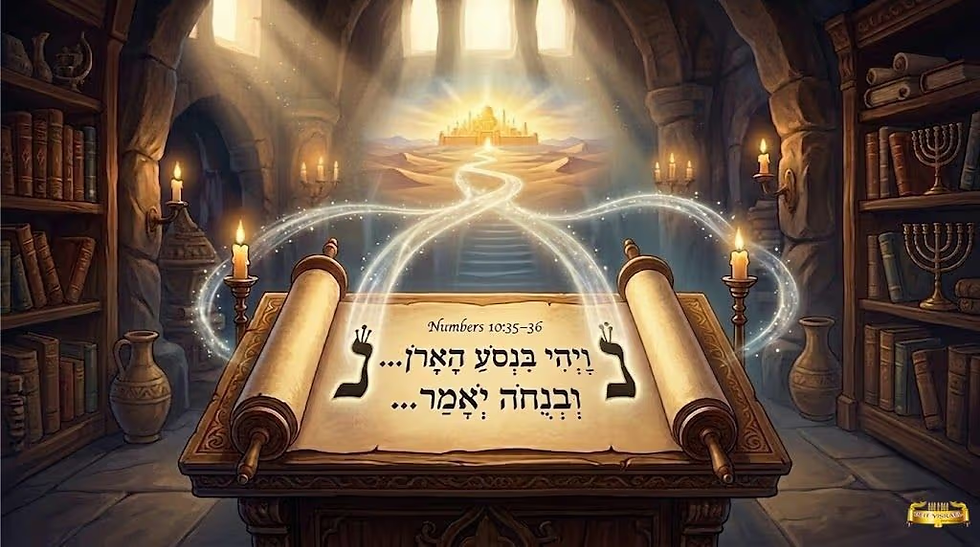
The passage of Numbers 10:35–36 is one of the most mysterious sections in the Torah:
“Whenever the Ark would journey, Moses said: Rise up, HaShem, and let Your enemies be scattered, and let those who hate You flee before You. And when it rested, he would say: Return, HaShem, to the myriads of thousands of Israel.”
These two verses are surrounded in the Torah scroll by two inverted letters nun, called nunim hafuchim.
The sages saw in this unusual sign a deep secret: these verses are not ordinary verses.
They are like a hidden book inside the Torah.
The Talmud teaches in Shabbat 115b–116a that these signs were placed before and after the passage to show that this section is separate.
Rabbi Yehudah HaNasi says that these two verses count as a separate book
According to this view, the Torah has seven books:
Genesis
Exodus
Leviticus
Numbers before this passage
The two verses of Numbers 10:35–36
Numbers after this passage
Deuteronomy
This is connected to the verse:
“Wisdom has built her house; she has hewn out her seven pillars.”
Proverbs 9:1
The Torah is normally revealed as five books, but in the inner dimension, it contains seven pillars of divine wisdom.
🔠 1. Why the Letter Nun?
The letter nun has a deep meaning in the writings of the sages.
Nun has the numerical value of 50.
It points to the Nun Sha’arei Binah, the Fifty Gates of Understanding.
These are the deep gates of divine comprehension.
Moshe Rabbeinu reached the highest levels of prophecy, and the sages teach that he attained forty-nine gates, while the fiftieth gate belongs fully to HaShem.
Nun also hints to falling, because the Hebrew root nafal means “to fall.”
In Ashrei, Psalm 145, every Hebrew letter appears except the letter nun.
The Talmud explains that the nun is omitted because it hints to the fall of Israel.
Yet immediately after the missing nun, the verse says:
“HaShem supports all who fall.”
Psalm 145:14
This means the nun contains both fall and restoration.
The inverted nun therefore hints to a world turned upside down.
Israel was supposed to move directly toward the Land, enter under Moshe’s leadership, build the Temple, and reveal redemption.
But because of complaint, desire, fear, and the later sin of the spies, the order became inverted.
The straight path of redemption became delayed.
Gaddi Ephraim Notes:
The inverted nun represents the hidden soul of Israel in exile.
The soul is not destroyed, but it is turned away from its true direction.
When the soul returns to Torah, prayer, humility, and the light of Mashiach, the inverted nun begins to turn upright again.
This is the work of tikkun.
🚩 2. The Ark Moving: The Throne of HaShem on Earth
The passage begins when the Ark travels.
The Ark was not merely a holy object.
It represented the Throne of HaShem in the lower world.
Inside it were the Tablets, the testimony of the covenant, and above it rested the Divine Presence between the keruvim.
When the Ark moved, it meant that the Divine Presence was leading Israel toward their destiny.
Moshe declared:
“Rise up, HaShem, and let Your enemies be scattered.”
This is not only a military prayer.
It is a cosmic declaration.
When the Ark moves, falsehood scatters.
Impurity retreats.
The enemies of holiness lose their hold.
The movement of the Ark is the movement of the Shechinah into history.
The Midrash teaches that the Ark would go before Israel and prepare the way.
Mountains were flattened, obstacles removed, and the path opened before them.
This shows that when Israel follows the Divine Presence, even impossible barriers become passable.
Gaddi Ephraim Notes:
The Ark moving forward is the image of divine mission.
When HaShem’s presence leads, the people do not walk by fear but by covenant.
Every generation has an “Ark movement”, a moment when Torah must move from hidden potential into action.
Beit Yisrael International carries this image: Torah must not remain locked in books alone; it must move through voices, languages, nations, homes, and souls.
🚪 3. The World of Potential and the World of Action
This section is filled with unrealized potential.
Israel was close to entering the Land.
The journey from Sinai to Eretz Yisrael could have been short.
The Ark was moving.
The cloud was above them.
Moshe believed he was leading the people into the promised inheritance.
This was the world of potential.
But immediately after this holy passage, the Torah begins recording complaints, cravings, spiritual breakdown, and eventually the tragedy of the spies.
The generation that stood at Sinai did not fully transform revelation into trust.
The sages teach that there are moments when redemption is near, but human choice can delay its revelation.
HaShem opens the gate, but Israel must walk through it with faith.
Gaddi Ephraim Notes:
The tragedy of the wilderness is not that HaShem was absent.
HaShem was present in the cloud, in the Ark, in the manna, in Moshe, and in the Torah.
The tragedy was that the people still carried Egypt inside their hearts.
Redemption is delayed when the soul sees the cloud above but still desires Egypt below.
🌍 4. Moshe’s Invitation to Chovav: The Nations Joining Israel
Before the Ark passage, Moshe invites Chovav, the son of Yitro, to journey with Israel:
“Come with us, and we will do good to you, for HaShem has spoken good concerning Israel.”
Numbers 10:29
This is deeply messianic.
Moshe is not only leading Israel.
He is inviting the righteous among the nations to attach themselves to the journey of Israel.
This reflects the prophetic vision of Zechariah:
“In those days, ten men from the nations of every language will take hold of the corner of a Jewish man’s garment, saying: Let us go with you, for we have heard that God is with you.”
Zechariah 8:23
The movement toward the Land was supposed to become a universal revelation.
Israel would enter the Land, establish holiness, build the Temple, and become a light to the nations.
Gaddi Ephraim Notes:
Chovav represents the souls from the nations who recognize the God of Israel and desire to walk with the covenant people.
The Torah of redemption does not erase Israel’s chosenness; it reveals why Israel was chosen:
To become a vessel through which divine light reaches the nations without idolatry, without confusion, and without detachment from Torah.
📖 5. The Hidden Book That Should Have Become Redemption
According to Rabbi Yehudah HaNasi , these two verses are a separate book
But why would a book of Torah be only two verses?
Because it represents a redemption that was almost revealed but became hidden.
This “book” contains the seed of what could have happened:
The Ark moving
Enemies scattering
Israel entering the Land
Moshe leading the people
The Temple being built
The Shechinah resting permanently among Israel
It is a small book because the potential was great, but the revelation was interrupted.
The inverted nuns are like brackets around a hidden messianic timeline.
They show that history took another route.
Gaddi Ephraim Notes:
The two verses are like a sealed scroll of potential redemption.
They contain the path that could have unfolded if Israel had fully trusted HaShem.
But even when the path was delayed, it was not erased.
The hidden book still remains in the Torah, waiting for its full awakening in the final redemption.
🏛️ 6. Moshe and the Temple That Could Not Be Destroyed
The sages and later commentators teach that if Moshe had entered the Land, the spiritual reality would have been completely different.
The Or HaChayim explains that had Moshe entered Eretz Yisrael and built the Beit HaMikdash, it would have possessed such holiness that it could never have been destroyed.
But if Israel later sinned, divine judgment would not have been able to fall upon the building.
It might have fallen upon the people themselves.
Therefore, HaShem prevented Moshe from entering the Land “for your sake.”
The Temple could later be destroyed as stone and wood, while Israel would survive exile and eventually return.
This reveals a fearful and compassionate mystery: Moshe’s exclusion from the Land became part of Israel’s protection.
Gaddi Ephraim Notes:
Moshe suffered outside the Land so that Israel could survive inside history.
This is the way of the true tzaddik.
The tzaddik bears pain for the people, not because the people deserve punishment, but because divine mercy seeks a way to preserve them.
This points toward the deeper pattern of Mashiach ben Yosef, who suffers in the process of gathering, repairing, and protecting Israel.
🕯️ 7. The Tzaddik Who Suffers for Israel
Moshe is not merely a leader.
He is the collective soul of Israel.
His life carries the burden of the people.
When Israel sins, Moshe prays.
When Israel falls, Moshe rises before HaShem.
When judgment threatens, Moshe stands in the breach.
The sages describe the tzaddik as the foundation of the world, based on Proverbs 10:25:
“The tzaddik is the foundation of the world.”
The tzaddik carries the spiritual weight of the generation.
In the deepest sense, Moshe’s inability to enter the Land was not a private punishment alone.
It was bound up with the destiny of Israel.
Gaddi Ephraim Notes:
The tzaddik is like the Menorah’s central stem.
From him, many flames are kindled.
Moshe’s spirit was placed upon the seventy elders, just as one candle lights many candles without losing its own flame.
The true tzaddik does not keep light for himself.
He multiplies it.
🌐 8. The Seventy Elders and the Seventy Nations
After the complaints of Israel, HaShem tells Moshe to gather seventy elders.
He places some of the spirit that was upon Moshe upon them.
This number is not accidental.
Seventy souls descended to Egypt.
Seventy elders received from Moshe.
Seventy nations represent the wider world.
Seventy faces of Torah reveal the fullness of divine wisdom.
Moshe’s spirit spreading to the seventy elders hints that Torah leadership must expand.
The light of Moshe must enter many vessels.
This also prepares the messianic mission: Israel must become a kingdom of priests and a holy nation, carrying divine wisdom to the seventy nations.
Gaddi Ephraim Notes:
The seventy elders are a prophetic image of Torah spreading through seventy languages and seventy channels of understanding.
The light must remain rooted in Moshe, but it must reach the outer edges of humanity.
This is the holy mission of spreading Torah without disconnecting it from its source.
☁️ 9. The Cloud of HaShem: Surrounding Light and Divine Protection
The passage begins with the cloud of HaShem:
“The cloud of HaShem was over them by day when they set forward from the camp.”
Numbers 10:34
The cloud represents divine protection, guidance, and concealment.
Fire reveals.
Cloud conceals.
Together they form the rhythm of the wilderness: clarity and mystery, revelation and hiddenness.
In Kabbalistic language, the cloud can be compared to or makif, surrounding light.
It is a light too great to be internalized fully.
It surrounds the people, protects them, and guides them even when they do not understand the path.
The Ark represents inner holiness.
The cloud represents surrounding holiness.
Together they show that Israel was guided from within and protected from above.
Gaddi Ephraim Notes:
The cloud teaches that even when redemption is hidden, HaShem is still guiding.
The soul may not see the full path, but it can walk beneath the cloud of faith.
The cloud does not mean absence; it means a higher light covered in mystery.
🔄 10. The Inverted Nuns and the Fall Before the Rise
The inverted nuns also show that the journey of Israel involves descent before ascent.
The nun hints to falling.
The inverted nun hints to a fall that is itself part of a hidden correction.
Israel falls through complaint, desire, fear, and exile.
But every fall becomes part of the greater return.
The sages teach:
“A descent is for the sake of ascent.”
This is one of the great principles of Chassidut.
The soul may descend into confusion, but through teshuvah, the soul can rise to a level even higher than before.
The two nuns surround the Ark passage like two boundaries around exile and redemption.
Between them is the voice of Moshe calling:
“Rise up, HaShem.”
This is the cry of all generations.
Gaddi Ephraim Notes:
The inverted nun is the cry of the soul when it is not yet aligned.
But the voice of Moshe inside the inverted nuns teaches that even inside disorder, the prayer of redemption is preserved.
The soul may be upside down, but the Ark is still moving.
⬆️ 11. The Secret of “Rise” and “Return”
The two verses contain two movements:
“Rise up, HaShem”
“Return, HaShem”
These are the two movements of divine history.
Rise up means the revelation of divine power against opposition.
Return means the resting of the Shechinah among Israel.
In spiritual life, these are also two stages.
First, HaShem rises to scatter the inner enemies:
fear
ego
impurity
confusion
exile consciousness
Then HaShem returns to dwell in the purified heart.
The journey of the Ark is therefore also the journey of the soul.
Gaddi Ephraim Notes:
Before the Shechinah rests, the enemies must scatter.
Before peace comes, inner Egypt must be broken.
Before the soul becomes a Mishkan, the Ark must move through the wilderness of the heart.
🕎 12. Connection to the Menorah
The passage appears in Parashat Beha’alotekha, which begins with the lighting of the Menorah.
The Menorah teaches inner illumination.
The Ark teaches divine movement.
The cloud teaches surrounding protection.
The seventy elders teach the spreading of spirit.
The inverted nuns teach hidden redemption.
The Menorah and the Ark are deeply connected.
The Menorah illuminates the inner chamber, while the Ark carries the covenant.
The Menorah is the light of wisdom; the Ark is the root of revelation.
Just as Aharon raises the lamps until they rise by themselves, Moshe raises Israel until they are ready to journey with the Ark.
But Israel was not yet ready.
The lamps were lit, but the desires of the people were still unrefined.
Gaddi Ephraim Notes:
The Menorah is the soul’s light.
The Ark is the soul’s covenant.
The cloud is the soul’s protection.
The journey is the soul’s mission.
Beha’alotekha teaches that light must become movement.
Torah must not only shine in the Mishkan; it must travel through the wilderness and transform the world.
✨ Final Spiritual Message
The nunim hafuchim reveal one of the deepest mysteries of the Torah: redemption was near, but history became inverted.
Moshe was ready.
The Ark was moving.
The cloud was guiding.
The Land was ahead.
The nations could have joined.
The Temple could have been built.
The Shechinah could have rested permanently.
But Israel still neededinner correction.
Therefore, the Torah preserves this passage as ahidden book, a book of what could have been and what still will be.
The two verses remain inside theTorah as aseed of future redemption:
“Rise up, HaShem”
“Return, HaShem”
This is the cry of Moshe.
This is the cry of Israel.
This is the cry of the Shechinah in exile.
This is the cry of the final redemption.
📜 Final Song Ephraim Notes
The inverted nuns teach that theworld is not yet in its proper order.
The Torah itself carries the sign ofexile,delay, andhiddenness.
But within that hiddenness is aseparate book of redemption.
The Ark is still moving.
The cloud is still guiding.
The light of Moshe is still kindling theseventy elders.
The soul of Mashiach is still gathering thescattered sparks.
The nations are still being invited to walk with theGod of Israel.
The hidden book is still waiting to be fully opened.
The mission of Beit Yisrael International is connected to this mystery: to help turn theinverted nun upright, to raise thefallen soul, to restore thehidden book, and to prepare hearts for the return of theShechinah.
When the Ark moves,enemies scatter.
When the Ark rests, theShechinah returns.
When the soul rises,exile begins to end.
When Israel returns, thehidden book becomesrevealed redemption.



Comments