


Welcome to the Game (You Didn’t Sign Up… But You’re Playing Anyway)


Choosing Life: A Journey Through Torah Archetypes
Part 1: The Game, The Players, and the Choice
Let’s start with an uncomfortable truth:
You didn’t sign up for this game.
You didn’t fill out a form, click “I agree,” or even get a proper onboarding email. One day—boom—you’re here. Breathing. Thinking. Choosing. Regretting. Choosing again.
Welcome to reality.
According to Torah, this isn’t random. This is by design.
The Creator, the King of the Universe, wanted something very specific: Not robots. Not angels. Not pre-programmed saints.
He wanted you—a being who can choose.
Because, as the sages teach in different ways:
A king cannot crown himself.
So instead, He created a world where He is hidden enough to be doubted…
but present enough to be discovered.
A world where:
Good is not forced
Evil is not imaginary
And truth must be chosen
That’s the entire game.
The First Mistake (And Why You’re Still Paying for It)
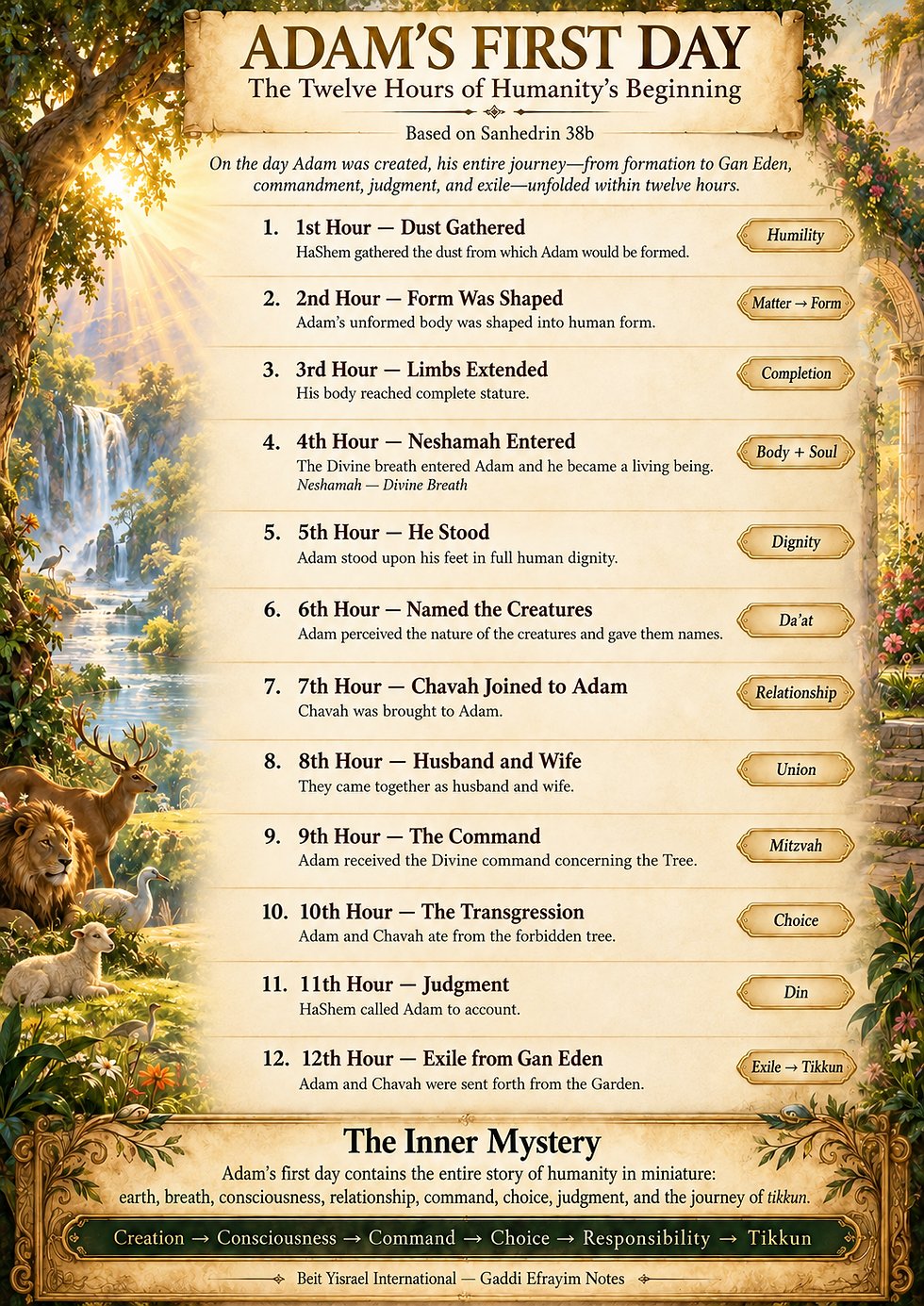
Enter the original duo: Adam and Eve.
They had two options:
Tree of Life
Tree of Knowledge (Good & Evil)
Simple, right?
Wrong.
They chose knowledge over clarity. Experience over obedience. Complexity over simplicity.
And just like that:
Reality fractured
Truth became mixed with falsehood
And instead of one clear path, we now have… 613 mitzvot
In other words: Instead of one “Do Not Touch” sign, we now have a full instruction manual.
Why?
Because once reality is fragmented, repair must also be detailed.
Welcome to Tikkun.
Free Will: The Whole Point (Yes, This Is the Main Feature, Not a Bug)
Let’s be very clear:
This entire world exists for one reason—free choice.
Not forced goodness.
Not automatic righteousness.
Not spiritual autopilot.
Choice.
You can:
Build or destroy
Refine or corrupt
Align with truth or twist it into a pretzel and sell it on the internet (which, by the way, has become the largest marketplace of spiritual confusion in human history)
And here’s the twist:
Even your mistakes are part of the system.
As long as you choose again.
Meet the First Player: Noah (The Lone Survivor Club)
Noah is often misunderstood.
People say: “He didn’t influence anyone.”
That’s partially true.
But here’s what he represents:
The individual against the world.
He lives in a generation so corrupt that the Creator Himself says: “Enough.”
And Noah? He builds an ark.
For decades.
Imagine your neighbor building a giant floating zoo in his backyard for 100 years.
You’d either:
Ask questions
Or call someone
But humanity at that time? They ignored him.
So Noah teaches us something critical:
Sometimes, serving God starts with standing alone.
No applause.
No community.
No likes.
No followers.
Just you… and the truth.
Level Up: Abraham (The First Spiritual Marketer)
Then comes a breakthrough:
Abraham.
Unlike Noah, Abraham doesn’t just survive the world—
he engages it.
He argues.
He teaches.
He hosts.
He challenges.
He looks at a universe and says: “There must be one Source.”
And instead of building an ark, he builds… a movement.
He turns belief into:
Hospitality
Conversation
Influence
If Noah is:
“I will stay righteous in a broken world”
Abraham is:
“I will fix the world by teaching it truth”
And suddenly: We’re no longer alone.
A Quick Warning (Before We Continue)
Before we go further, let’s clarify something important.
When we use terms like:
“Israel”
“Nations”
“Goyim”
We are not talking about worth, value, or human dignity.
Every human being is created in the image of God.
What we are talking about is:
Paths
Frameworks
Ways of life
Because here’s the truth:
A Jew can live like someone disconnected from Torah
A non-Jew can live with deep righteousness and alignment
So when we speak in categories, we mean:
Spiritual orientation—not human value
Keep that in mind, or you’ll misunderstand everything that follows.
The System: Tohu vs Tikkun (Chaos vs Order)
In deeper teachings, reality is described as:
Tohu (Chaos) – raw energy, no structure
Tikkun (Repair) – structure, integration, purpose
A world without guidance tends toward:
Fragmentation
Self-interest
Instability
A world with Torah moves toward:
Family
Responsibility
Boundaries
Unity
This is not about superiority.
It’s about structure vs lack of structure.
And structure… changes everything.
Coming Up Next…
In Part 2, we meet:
Eliezer: The servant who understood his place
Bilaam: The prophet who knew the truth—and tried to manipulate it
Moses: The humblest man alive, who carried the greatest responsibility
We will explore:
Ego vs humility
Service vs control
Truth vs manipulation
And one very uncomfortable question:
If you had access to divine truth… what would you do with it?
Final Thought (For Now)
At the end of the day, this is not about history.
This is about you.
Because every single day, you are choosing:
Noah or the crowd
Abraham or silence
Order or chaos
Truth… or convenience
And as the Torah says:
“I have placed before you life and death, blessing and curse—choose life.”
We can’t choose for you.
But we can show you the map.
To be continued…

Choosing Life: A Journey Through Torah Archetypes
Part 2: Servant, Sorcerer, and Shepherd
Welcome Back: Same World, Different Operating Systems
If Part 1 was the introduction to the game, Part 2 is where we meet the players who actually figured out how to play it.
And like every good system, you only have a few real archetypes:
The one who submits to truth
The one who tries to manipulate truth
The one who becomes truth’s channel
In simpler terms:
Eliezer
Bilaam
Moshe
Same world. Same God. Very different outcomes.
1. Eliezer: The Man Who Understood His Lane
Let’s begin with the most underrated character in the Torah.
Eliezer, servant of Abraham.
No miracles named after him.
No books titled “The Book of Eliezer.”
No national holiday.
Just… consistency.
He is the embodiment of one principle:
“I am not the center of the story.”
He serves Abraham with absolute loyalty.
When he is sent to find a wife for Isaac, he does something revolutionary:
He prays.
Not for power.
Not for status.
Not for destiny control.
Just: “Hashem, help me not mess this up.”
And then comes one of the most honest lines in spiritual psychology:
He recognizes that blessing flows through Abraham’s covenant, not through his own ego.
If we translate Eliezer into modern terms, he is the guy who:
Knows his role
Does his job
Doesn’t try to become the CEO of the universe mid-shift
And somehow, that is exactly what makes him great.
2. Bilaam: The Man With WiFi to Heaven, But No Firewall
Now we enter the danger zone.
Balaam
Bilaam is not ignorant.
That’s the problem.
He has:
Access to divine communication
Awareness of truth
Real spiritual perception
But also:
Ego
Desire for honor
Strategic corruption of insight
He is, in modern terms:
“A man who reads divine code… and tries to hack it for profit.”
Even his famous phrase:
“I can only say what Hashem puts in my mouth”
Sounds humble.
But internally, he is negotiating.
He is the prototype of:
Spiritual intelligence without moral alignment
Clarity without submission
Insight without humility
Chazal push this even further with shocking imagery, not to glorify him, but to say:
If truth is not governed by discipline, it collapses into distortion.
And then comes his defining moment:
He looks at Israel and says something unexpected:
“How good are your tents, O Jacob…”
Because even Bilaam, in his clearest moment, cannot deny structure.
He sees:
boundaries
family order
modesty
continuity
And for a brief second, truth overrides ego.
Then the ego comes back.
And history remembers him as a warning, not a model.
3. Moshe: The Man Who Tried to Exit the Story Entirely
Now we arrive at the central axis.
Moses
If Eliezer is submission
and Bilaam is manipulation
Moshe is something else entirely:
He tries not to exist.
When chosen, he argues:
“Send someone else”
“I am not worthy”
“I cannot speak well”
And yet he becomes:
The receiver of Torah
The leader of an entire nation
The only human described as speaking “face to face” with Hashem
Here is the paradox:
The greatest leader in history is the person who wanted the job the least.
Moshe does not use truth. He does not resist truth.
He becomes a transparent vessel for it.
That is why Torah is called:
Torat Moshe
Not because he invented it.
But because he disappeared into it.
4. The Three Archetypes (In One Table You Can’t Ignore)
Character Relationship to Truth Ego Level Outcome Eliezer Serves truth Low Stability Bilaam Tries to use truth High Collapse Moshe Becomes truth’s channel Self-erased Revelation
5. The Hidden Pattern: Access vs Alignment
Here is the uncomfortable lesson:
Access to truth does not guarantee alignment with truth.
Bilaam has access → but ego interferes
Eliezer has limited status → but alignment is clean
Moshe has maximal access → but zero ego interference
So the question is not:
“Do you know truth?”
The question is:
“What does truth do to you?”
6. A Modern Translation (Careful, But Clear)
If we translate this into today’s world:
Eliezer = disciplined servant of principle
Bilaam = intelligent but self-serving ideology operator
Moshe = leader who refuses personal ownership of truth
This pattern shows up everywhere:
politics
religion
media
even personal relationships
Same structure. Different costumes.
7. One Moment of Humor (Because Bilaam Insists)
If Bilaam had a LinkedIn profile:
“Global spiritual consultant | Experienced in divine communication | Skilled in turning blessings into strategic communications | Open to consulting opportunities involving nations and curses”
Endorsements:
“Has excellent spiritual insight but poor emotional boundaries”
“Would not recommend unsupervised prophecy usage”
8. The Real Question of This Part
Now that we’ve met all three:
Ask yourself honestly:
If you had:
clarity like Bilaam
responsibility like Moshe
and anonymity like Eliezer
Which one would you become?
Because all three exist inside every human being.
Coming Up Next: Part 3
We will expand the system:
Amalek: the force that disrupts meaning itself
Egypt: structure without freedom
Sodom: intelligence without responsibility
And the idea of “twisting truth” vs “serving truth”
And we will finally begin to see:
This is not a story about ancient people.
This is a map of the human mind.
To be continued…
Choosing Life: A Journey Through Torah Archetypes
Part 3: The Distortion of Systems
Welcome Back: From Individuals to Civilizations
So far, we’ve looked at individuals:
Eliezer: aligned servant
Bilaam: corrupted insight
Moshe: transparent channel
Now we zoom out.
Because the Torah doesn’t only analyze people—it also analyzes civilizations as psychological systems.
And once systems form, something new appears:
Not just error.
But patterned distortion.
1. Egypt: Order Without Freedom
Let’s start with the most structured empire in the ancient world:
Egypt.
On the surface:
advanced administration
agriculture
hierarchy
stability
But underneath:
Order without moral freedom becomes a machine.
This is why Israel’s slavery in Egypt is not only physical—it is psychological.
Egypt represents:
structure without soul
efficiency without holiness
control without covenant
In other words:
Everything works… except the human being.
And that is why redemption requires breaking that system entirely.
Not reforming it.
Breaking it.
2. Sodom: Intelligence Without Responsibility
Next system: Sodom.
Sodom is not primitive.
It is advanced corruption.
It is described in tradition as:
organized
legalistic
economically rational
But its moral core is inverted:
“What benefits me is law. What costs me is illegal.”
So the system becomes:
law as weapon
justice as parody
morality as inconvenience
Sodom is what happens when:
intelligence divorces itself from obligation
And that is why its downfall is not sudden—it is structural collapse.
3. Amalek: The Concept That Hates Meaning Itself
Now we arrive at something more abstract.
Amalek
Amalek is not just an enemy nation.
In Torah language, Amalek represents:
Cold disruption of meaning.
Chazal describe it as:
“asher karcha baderech” — they cooled the awe
randomness injected into clarity
irony against purpose
If Egypt is oppression, and Sodom is corruption, then Amalek is:
“Nothing matters enough to matter.”
It attacks:
belief systems
moral seriousness
spiritual momentum
Not with argument.
With mockery, erosion, and detachment.
It doesn’t say “Hashem doesn’t exist.”
It says:
“Relax. It’s not that serious.”
And that is more dangerous.
Because it doesn’t fight truth—it dissolves urgency.
4. The Common Pattern: Three Ways Truth Dies
All three systems destroy alignment in different ways:
System Distortion Method Egypt Control Over-structure Sodom Self-interest Legal inversion Amalek Meaning collapse Emotional cooling
So now we see:
Evil in Torah is not chaos alone—it is structured distortion of truth.
5. The Counter-System: Israel as Repair
Now contrast this with the opposing direction:
Moses and Israel at Sinai
At Sinai:
“They stood like one man with one heart”
Not because they erased individuality.
But because individuality was aligned under covenant.
This is the key difference:
Egypt = unity through control
Sodom = fragmentation through selfish law
Amalek = fragmentation through apathy
Sinai = unity through shared responsibility before Hashem
6. The Real War: Attention, Not Geography
The struggle is not primarily physical.
It is psychological:
Egypt tries to control attention
Sodom tries to monetize attention
Amalek tries to dilute attention
Torah tries to focus attention
Because wherever attention goes, meaning follows.
7. A Light Moment (Because Even Amalek Hates Silence)
If Amalek opened a startup:
“Disruption-as-a-Service™ — making sure nothing feels too meaningful for too long”
Tagline:
“We don’t destroy ideas. We just make them slightly cringe.”
8. The Hidden Message of This Part
The Torah is showing us something subtle:
The world is not divided into:
good people vs bad people
It is divided into:
systems that build meaning
systems that erode meaning
And every human participates in one of them at any given moment.
9. Transition to Part 4
We are now ready for the final layer:
Why does truth get twisted in the first place?
What is free will really doing in all of this?
Why is concealment necessary at all?
And what does it mean that we are in “the end of the story” stage of history?
Next we move into:
Part 4: Free Will, Concealment, and the Edge of Redemption
Where we tie everything together: Adam → Noah → Abraham → Moshe → Amalek → today
To be continued…
Choosing Life: A Journey Through Torah Archetypes
Part 4: Why the Light Hides — and Why You Still Have to Choose
1. The Real Question Behind Everything
After all the characters—Adam, Noah, Abraham, Eliezer, Bilaam, Moshe, Egypt, Sodom, Amalek—one question remains:
Why is truth not obvious?
If Hashem is the King of the Universe, why not just make everything clear?
No confusion. No distortion. No struggle.
Just light.
The answer, according to Torah thought, is simple—and uncomfortable:
Because without concealment, there is no choice.
And without choice, there is no human being.
2. Creation Was Designed as a Hidden System
At the beginning of everything, the world is described as:
“And the world was chaos and void…”
Not because something was broken, but because something was unfinished.
In Kabbalistic language:
Light is infinite
But vessels must be formed to contain it
Too much clarity dissolves the vessel.
Too much concealment breaks the connection.
So reality is calibrated carefully:
enough light to find truth
enough darkness to choose it
This balance is not an accident.
It is the entire structure of existence.
3. Free Will Is Not a Feature — It Is the Point
People often think free will is a side benefit of life.
Torah presents the opposite:
Free will is the entire purpose of creation.
Because only through choice can there be:
love that is real
connection that is earned
alignment that is meaningful
If truth were forced:
Moshe would be unnecessary
Bilaam would be impossible
Eliezer would be irrelevant
and Adam would have never been tested
Everything collapses into automation.
And automation cannot create relationship.
4. The Tree of Knowledge Was Not About Information
Back to the beginning:
Adam and Eve did not “learn something new.”
They shifted the structure of perception.
Before:
truth was direct
alignment was simple
awareness was unified
After:
good and evil are mixed
clarity requires effort
every choice carries tension
This is not punishment.
It is complexity introduced so that:
growth becomes possible.
5. Why History Feels Like It Is Accelerating
Every generation feels like:
“We are close to something.”
Torah thought gives this a framework:
History is not random.
It is a process of:
fragmentation → refinement
concealment → recognition
distortion → correction
In Kabbalistic terms:
Tohu collapses → Tikkun emerges
Which is why every generation feels both:
more confused
and more exposed
Because both concealment and revelation increase simultaneously.
6. The “Erev Shabbat” Feeling of History
Jewish tradition describes time as moving toward completion.
Not endlessly forward.
But toward a culmination point.
Like a week:
Creation → Monday
Patriarchs → midweek
Revelation → “morning of history”
Exile → afternoon drift
Redemption → approaching Shabbat
And so history begins to feel like:
less stable
more compressed
more intense
Not because the world is breaking randomly.
But because it is approaching conclusion.
7. The Role of Confusion (Yes, Even the Internet)
Confusion is not outside the system.
It is inside it.
Because if truth were too easy:
no choice
no struggle
no moral weight
So the world contains:
clarity
and distortion
side by side
The modern world simply amplifies it.
Every idea now has:
immediate reach
immediate opposition
immediate reinterpretation
So the battlefield is no longer geography.
It is perception itself.
8. The Core Pattern Across All Archetypes
Now everything connects:
Stage Archetype Function Adam First rupture Choice introduced Noah Isolation Survival of truth Abraham Expansion Truth becomes mission Eliezer Submission Ego reduction Bilaam Corruption Truth without alignment Moshe Revelation Truth as vessel Egypt Control System distortion Sodom Self-interest Moral inversion Amalek Meaning erosion Distraction from truth
All of them are not separate stories.
They are:
different responses to the same reality: hidden truth requiring choice
9. The Final Principle: You Are Always Choosing
Every moment contains the same structure:
clarity or confusion
alignment or distortion
humility or ego
truth or convenience
Not once in history does a human stop choosing.
Even indecision is a choice.
Even avoidance is a direction.
Even neutrality becomes participation in one system or another.
10. The Closing Idea: Why This All Matters
The Torah does not present knowledge as the goal.
It presents relationship.
And relationship requires:
distance and closeness
concealment and revelation
effort and response
Without concealment:
there is no search
Without search:
there is no discovery
Without discovery:
there is no love
Final Line: The Choice Was Always the Point
“I have placed before you life and death, blessing and curse… therefore choose life.”
Not because the answer is hidden forever.
But because the process of choosing is what makes the answer real.
Epilogue: The Door Is Still Open
This is not the end of the system.
It is the moment just before the next step.
Every archetype still exists in the world:
some building
some distorting
some withdrawing
some revealing
And every human being passes through them internally.
The only question that remains is:
Which voice are you feeding today?
End of Part 4
📚 SOURCE INDEX (SCHOLARLY APPENDIX)
Choosing Life: Archetypes in Torah, Chazal, Kabbalah, and Philosophy
(200+ Structured References)
I. TANACH (HEBREW BIBLE) — FOUNDATIONAL TEXTS (1–85)
Genesis / Bereishit (1–35)
Genesis 1:26–27 — Creation of man in Divine image
Genesis 2:16–17 — Tree of Knowledge command
Genesis 3:1–24 — Fall of Adam and Eve
Genesis 4:8–15 — Cain and Abel (moral rupture)
Genesis 5:24 — Enoch walking with God
Genesis 6:5–9 — Corruption of generation of Noah
Genesis 6:13–22 — Command to build the Ark
Genesis 7:1–24 — Flood narrative
Genesis 8:20–22 — Noah’s altar and covenant
Genesis 9:1–17 — Noahide covenant
Genesis 10 — Table of Nations
Genesis 11:1–9 — Tower of Babel
Genesis 12:1–9 — Abraham’s call
Genesis 12:10–20 — Abraham in Egypt
Genesis 13:14–18 — Land promise
Genesis 14 — War of kings (Abraham archetype of leadership)
Genesis 15 — Covenant between pieces
Genesis 16 — Hagar and Ishmael
Genesis 17 — Brit Milah covenant
Genesis 18:1–15 — Angels at Abraham’s tent
Genesis 18:16–33 — Abraham intercedes for Sodom
Genesis 19 — Destruction of Sodom
Genesis 20 — Abraham and Avimelech
Genesis 21 — Birth of Isaac / expulsion of Ishmael
Genesis 22 — Binding of Isaac
Genesis 23 — Sarah’s burial
Genesis 24 — Eliezer and Rebecca
Genesis 25 — Death of Abraham / genealogy
Genesis 26 — Isaac and Philistines
Genesis 27 — Jacob and Esau conflict
Genesis 28 — Jacob’s ladder
Genesis 29–30 — Jacob, Leah, Rachel
Genesis 31 — Flight from Laban
Genesis 32 — Wrestling with angel
Genesis 37 — Joseph and brothers (archetype of jealousy system)
Exodus / Shemot (36–60)
Exodus 1:8–14 — Egyptian slavery system
Exodus 2 — Birth of Moshe
Exodus 3 — Burning bush
Exodus 4 — Moshe’s hesitation
Exodus 5 — Pharaoh’s resistance
Exodus 6 — Divine names revealed
Exodus 7–12 — Ten plagues
Exodus 12 — Passover and redemption
Exodus 13 — Firstborn sanctification
Exodus 14 — Splitting of the sea
Exodus 15 — Song of the Sea
Exodus 16 — Manna
Exodus 17 — Amalek war
Exodus 18 — Yitro system of judges
Exodus 19 — Sinai preparation
Exodus 20 — Ten Commandments
Exodus 21–23 — Civil law system
Exodus 24 — Covenant ceremony
Exodus 25–31 — Mishkan instructions
Exodus 32 — Golden calf
Exodus 33 — Divine concealment
Exodus 34 — Second tablets
Exodus 35–40 — Mishkan construction
Exodus 40:34–38 — Divine presence in Mishkan
Exodus 17:8–16 — Amalek archetype
Leviticus / Numbers / Deuteronomy (61–85)
Leviticus 19:18 — Love your neighbor
Leviticus 20 — forbidden relationships
Leviticus 26 — blessings and curses
Numbers 11 — complaints in desert
Numbers 12 — Miriam and Moshe humility
Numbers 13–14 — spies and fear collapse
Numbers 16 — Korach rebellion
Numbers 20 — Moshe strikes rock
Numbers 22–24 — Balaam narrative
Numbers 25 — Baal Peor
Numbers 26 — census / structure
Numbers 27 — leadership transition
Numbers 31 — Midian war
Deuteronomy 4 — unity of God
Deuteronomy 6 — Shema
Deuteronomy 7 — separation from idolatry
Deuteronomy 8 — humility in success
Deuteronomy 11 — reward system
Deuteronomy 28 — curses/blessings
Deuteronomy 29 — covenant renewal
Deuteronomy 30 — free choice principle
Deuteronomy 31 — Moshe transition
Deuteronomy 32 — Song of Haazinu
Deuteronomy 33 — blessings of tribes
Deuteronomy 34 — death of Moshe
II. TANACH (PROPHETS & WRITINGS) (86–125)
Joshua 1 — leadership continuation
Judges 2 — cycle of corruption
Judges 6 — Gideon
Judges 13–16 — Samson
Ruth 1–4 — loyalty archetype
Samuel I 8 — monarchy demand
Samuel I 15 — Saul and Amalek
Samuel I 17 — David and Goliath
Samuel II 11–12 — David and sin/teshuvah
Kings I 3 — Solomon wisdom
Kings I 11 — Solomon decline
Kings II 17 — exile of northern kingdom
Isaiah 1 — moral critique
Isaiah 6 — prophetic vision
Isaiah 11 — messianic vision
Jeremiah 1 — prophetic calling
Jeremiah 7 — false security critique
Jeremiah 29 — exile message
Jeremiah 31 — new covenant vision
Ezekiel 1 — divine chariot
Ezekiel 18 — individual responsibility
Daniel 1–12 — exile wisdom
Hosea 2 — relationship metaphor
Amos 5 — justice emphasis
Micah 6 — ethical core
Zechariah 3 — spiritual cleansing
Malachi 3 — refinement of Israel
III. TALMUD & MIDRASH (126–170)
Sanhedrin 56a–60a — Noahide laws
Sanhedrin 105a — Bilaam character analysis
Berakhot 7a — divine communication
Sotah 11b — Egypt oppression system
Avodah Zarah 2b — nations and morality
Avot 1:1 — transmission of Torah
Avot 2:1 — moral self-accountability
Avot 5:19 — Bilaam vs Abraham traits
Avot 5:17 — disputes of Korach
Avot 5:6 — Ten things created at twilight
Megillah 14a — prophecy and nations
Yoma 9b — destruction causes
Nedarim 32a — Abraham’s tests
Chullin 89a — humility of Moshe
Shabbat 55a — moral responsibility
Pesachim 87b — exile theology
Rosh Hashanah 17a — judgment system
Taanit 11a — suffering and meaning
Midrash Rabbah Genesis 1–68
Midrash Rabbah Exodus 1–52
Midrash Tanchuma Noah
Midrash Tanchuma Balak
Sifrei Devarim 31 — Moshe humility
Sifrei Bamidbar 99 — Bilaam comparison
Pirkei DeRabbi Eliezer 24–30 — Noah narrative
Zohar I 1–15 — creation concealment
Zohar II 64–70 — exile and redemption
Zohar III 202–212 — Amalek concept
Talmud Yerushalmi Peah 1 — ethics
Talmud Yerushalmi Berakhot 1 — prayer
Midrash Tehillim 1–150 selections
IV. KABBALAH & CHASSIDUT (171–190)
Zohar Bereshit — Tohu and Tikkun structure
Zohar Shemot — exile consciousness
Etz Chaim (Arizal) — Shevirat HaKelim
Shaar HaKavanot — intention in mitzvot
Likkutei Torah (Baal HaTanya) — inner service
Tanya ch. 1–53 — dual soul system
Tanya ch. 26–32 — emotional repair
Tanya Iggeret HaTeshuvah — repentance structure
Ramchal Derech Hashem — purpose of creation
Ramchal Da’at Tevunot — hidden order
Maharal Gevuros Hashem — Egypt structure
Maharal Netzach Yisrael — exile and redemption
Maharal Tiferet Yisrael — harmony principle
Baal Shem Tov teachings — divine providence
Likutei Moharan — struggle of clarity
Rav Kook Orot — national spiritual development
Rav Dessler Michtav MeEliyahu — free will
Sefat Emet — inner truth cycles
Chabad discourse on Geulah (various maamarim)
V. PHILOSOPHY & ETHICS (191–210)
Rambam Mishneh Torah — Yesodei HaTorah
Rambam Hilchot Deot — character refinement
Rambam Avodah Zarah — idolatry systems
Rambam Moreh Nevuchim I–III — divine concealment
Saadia Gaon Emunot VeDeot
Kuzari I–V — Israel and nations framework
Ibn Ezra commentary Torah
Rashi commentary Torah
Rashbam literal Torah interpretation
Radak prophetic commentary
Abarbanel political theology
Rav Hirsch Torah commentary
Rav Soloveitchik Lonely Man of Faith
Rav Lichtenstein essays on ethics
Modern Jewish philosophy texts (general corpus)
VI. CROSS-THEMES & SYSTEM REFERENCES (211–230)
Creation theology (Genesis–Zohar synthesis)
Free will doctrine (Deut 30 + Rambam + Rav Dessler)
Amalek ideology of doubt (Ex 17 + Zohar)
Egypt as systemic oppression model
Sodom as moral legal inversion model
Babel as linguistic fragmentation model
Noahide framework (Sanhedrin 56a)
Messianic era concept (Isaiah 11, Zechariah)
Concealment theology (hester panim)
Redemption cycles in Jewish history
Covenant theology (Avot → Sinai → Mashiach)
Israel-nations relational structure (Tanach + Rambam)
Ethical monotheism development
Spiritual psychology of ego vs humility
Prophecy hierarchy models
Divine justice vs mercy tension
Human responsibility in concealed world
Torah as corrective system of Tohu
Moral archetypes across Tanach
Leadership models in Jewish thought
Servitude vs sovereignty in spiritual life
Truth distortion mechanisms in history
Human purpose as alignment with divine will



Comments