


Parashat Shemot 5786 -10 January 2026 / 21 Tevet 5786

Updated: Jan 8
“Gaddi’s Notes on the Eternal Wisdom of the Prominent Sages”: Shemot: The Power of Names in Exile and Redemption

Shemot: When the Soul Recalls Its True Name
This is why the book of redemption does not start with miracles—but with names. Because before God redeems a people, He remembers who they are.
Shemot – Names, Exile, and the Hidden Continuity of Redemption
The book of Shemot opens not with suffering, not with slavery, but with names:
“These are the names of the sons of Israel who came to Egypt…” (Exodus 1:1)
The sages ask a powerful question: Why repeat the names, when they were already listed at the end of Bereishit?
Rashi, quoting Midrash Rabbah, answers:
“God counted them again out of love… to make known that they were still precious to Him.” (Shemot Rabbah 1:5)
This teaches a foundational truth: Exile does not erase identity. Even when Israel descends into concealment, their shem—their inner spiritual signature—remains intact.
From the perspective of Beit Yisrael, this is the first act of redemption: remembering who you are before circumstances define you.
Gaddi Efrayim often emphasizes that exile begins externally, but redemption begins internally, when the soul remembers its name.
Names as Channels of Spiritual Reality
Our sages teach that a name is not a label—it is a channel.
The Arizal explains:
“The name given to a person is drawn from Ruach HaKodesh and reveals the root of the soul.” (Sha’ar HaGilgulim, Introduction 23)
This is why changing a name changes destiny, as seen repeatedly in Torah. A name aligns the soul with a new spiritual configuration, opening different pathways of light and responsibility.
From Beit Yisrael’s teachings, a name is understood as:
A frequency of the soul
A vessel for divine mission
A contract between heaven and earth
Thus, when a new stage of life begins, the soul often requires a new spiritual interface—a new name.
Hebrew Letters: The Building Blocks of Creation
This concept reaches its deepest explanation in Sefer Yetzirah, which teaches that the universe was created through:
10 Sefirot (divine emanations)
22 Hebrew letters (foundational forces)
Together, they form the 32 Paths of Wisdom(Netivot Chochmah).
The number 32 corresponds to the Hebrew word Lev (לב)—heart.
The sages point out something astonishing:
The first letter of the Torah is Beit
The last letter of the Torah is Lamed
Together they spell לב — heart.
This reveals that creation flows through divine speech filtered through the heart, meaning that reality itself responds to how divine letters are arranged,spoken, and lived.
Gaddi Efrayim teaches that human speech mirrors divine speech—when we use words consciously, especially in Lashon HaKodesh, we participate in ongoing creation.
“Let There Be Light” — Creation Through Letters
The phrase “Yehi Ohr”( “Let there be light”) illustrates this divine process:
First, letters are formed
Then, letters combine into words
Then, words are spoken
Then, reality manifests
This is why Hebrew is called Lashon HaKodesh—the Holy Tongue: not merely sacred by tradition, but creative by nature.
The Talmud states:“The ministering angels do not understand Aramaic.”(Sotah 33a)
Pirkei d’Rabbi Eliezer explains that angels communicate in Hebrew because Hebrew operates in the upper worlds.
Beit Yisrael emphasizes that when Israel speaks Hebrew— even imperfectly—they are reawakening dormant channels of light embedded in creation itself.
Abram → Abraham: One Letter, Infinite Expansion
The Torah records a subtle but world-altering transformation:
Abram → Abraham
The Midrash explains: Abram means“exalted father”, while Abraham means“father of many nations.”
The added letter ה (Heh) is not arbitrary:
It is a letter from the Divine Name
It represents breath, expansion, and revelation
It corresponds to Malchut receiving divine influx
The Zohar teaches that by adding the Heh, God expanded Abram’s spiritual capacity to influence worlds beyond himself.
Gaddi Efrayim notes that true expansion in life never comes fromeffort alone— it comes when divine breath enters the vessel.
Hoshea → Yehoshua: Protection Through the Name
Similarly, Moses changes Hoshea's name:Hoshea → Joshua
Rashi explains:“May God save you from the counsel of the spies.” (Numbers 13:16)
Here, the letter י (Yud) — the smallest letter — represents:
Divine wisdom (Chochmah)
Hidden protection
Alignment with God’s will
The addition of Yud turns salvation (Hoshea) into “God is salvation” (Yehoshua). Beit Yisrael teaches that this name change anchored Yehoshua to emunah in action, allowing him to stand firm when others collapsed spiritually.
Shemot and Our Generation
The opening of Shemot speaks directly to our generation:
You can be in Egypt and still be named
You can be enslaved and still be chosen
You can feel forgotten and still be counted
Gaddi Efrayim often teaches that redemption begins internally— when the soul hears its true name again, even before the chains are broken.
This is why the Book of Redemptiondoes not begin with miracles—but with names.
Because before God redeems a people, He remembers who they are.
Beit Yisrael Closing Insight
In the path of Beit Yisrael, Shemot teaches us that:
Names preserve identity in exile
Letters shape destiny
Divine speech continues through human mouths
A single letter can redirect history
And most importantly: When Israel remembers its name, Egypt begins to fall
The Burning Bush and the Five Powers of the Soul
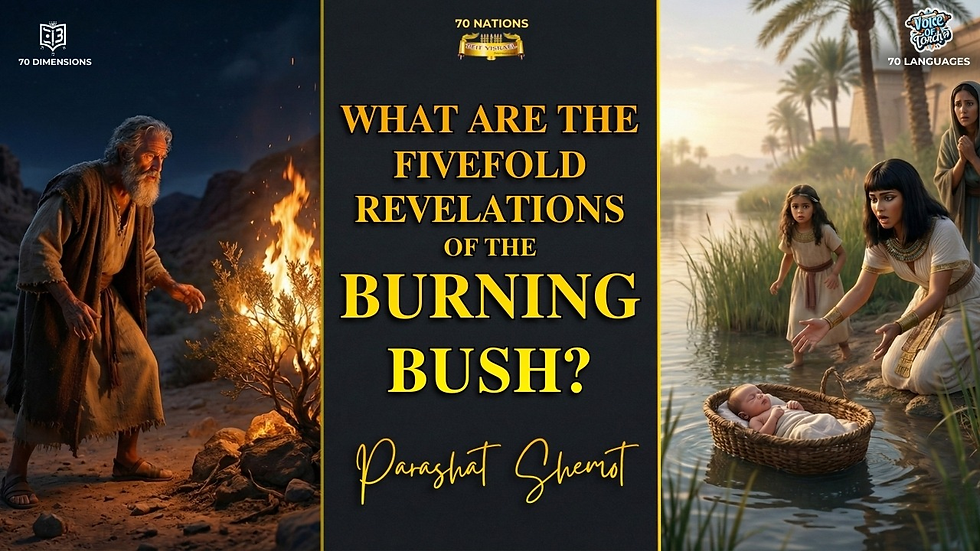
Below is a structured, sages-based exploration of the Five Interpretations of the Burning Bush, faithful to Midrash, Zohar, Chassidut, and classical Jewish thought.
The Fivefold Revelation of the Burning Bush
A Map of Divine Revelation and the Soul
The Torah emphasizes the word “the bush” (הַסְּנֶה) five times in the account of Moses’ encounter (Exodus 3). The Midrash teaches that this repetition is deliberate, signaling five principal layers of meaning—a complete spiritual spectrum.
These five interpretations correspond not only to five dimensions of divine revelation, but also to the five emotive faculties of the soul, rooted in the heart (lev) and reflected in the five patriarchal soul-roots that Moses integrates within himself.
1. Omnipresence: God in All Reality (Chesed – Abraham)
The bush represents all of reality.
The fire represents divine revelation.
God chooses a lowly thornbush, rather than a majestic tree, to reveal a foundational truth:There is no place devoid of Him. (Zohar I, 3b)
The Midrash explains that even the lowest form of existence contains divine presence. This revelation awakens love—the soul’s attraction toward God—because omnipresence means accessibility.
This interpretation corresponds to:
Chesed (loving-kindness)
Abraham, who revealed monotheism by teaching that God is everywhere
To recognize God in all things is to awaken love, because the soul yearns naturally toward what it perceives as all-encompassing.
2. Shared Suffering: God in Exile (Gevurah – Isaac)
The bush represents Israel suffering in exile.
The fire represents the Shekhinah suffering with them.
The sages teach:“In all their suffering, He suffers.” (Isaiah 63:9; cited in Midrash Rabbah)
Here, divine presence is not comforting warmth—it is painful fire. This reflects awe, restraint, and judgment—the second emotional power of the soul.
This interpretation corresponds to:
Gevurah (awe / restraint)
Isaac, whose life embodied sacrifice, endurance, and hidden suffering
Faith during exile is born not from comfort, but from the knowledge that God has entered our pain.
3. Harmonized Opposites: Nature and Miracle (Tiferet – Jacob)
Fire burns, yet the bush is not consumed.
The Midrash adds a striking detail: Moses took five steps toward the bush. This signals a movement toward beauty (Tiferet)—the harmonious blending of opposites.
Beauty emerges when:
Nature and miracle coexist
Law and transcendence interpenetrate
Fire burns without destruction
This interpretation corresponds to:
Tiferet (beauty / compassion)
Jacob, who harmonized opposing forces and investigated divine patterns within nature
Jacob’s scientific-spiritual inquiry into Laban’s flocks reflects the same impulse: to uncover divine order within the natural world.
4. Eternity: Israel Cannot Be Consumed (Netzach – Moses)
The fire now represents Egyptian oppression.
The bush represents Israel.
Naturally, oppression should consume a nation. But Israel endures. This reveals the principle of eternity:“I, God, have not changed, and you, the children of Jacob, have not been consumed.” (Malachi 3:6)
This interpretation corresponds to:
Netzach (victory / eternity)
Moses, the soul of endurance and redemptive perseverance
Entropy governs nature—but Israel transcends entropy because their root lies beyond time.
5. Thorns and Roses: Good and Evil Within Israel (Hod – Inner Truth)
The bush is thorny, yet it produces fragrant flowers.
The Zohar teaches:The thorns fuel the fire, but the branches, fruit, and leaves are preserved.
This teaches that within Israel:There exist both great righteousness and deep corruption.
Evil feeds destructive fire, but holiness cannot be consumed.
Rabbi Shneur Zalman of Liadi explains that this interpretation penetrates deepest into the verse:“I have not changed… and you have not been consumed.”Even internal contradiction does not destroy Israel, because divine essence remains untouched.
This interpretation corresponds to:
Hod (truth, acknowledgment, humility)
The recognition that holiness persists even when obscured
The Integrated Teaching of the Five
Together, the five interpretations reveal:
God is everywhere
God suffers with Israel
God harmonizes opposites
Israel is eternal
Holiness survives even internal darkness
Moses stands at the center of all five, integrating:
Abraham’s love
Isaac’s awe
Jacob’s beauty
His own endurance
And Israel’s inner truth
Only a soul containing all five dimensions can redeem a fractured world.
Conclusion
The burning bush is not merely a miracle—it is a map of reality, a portrait of the soul, and a blueprint of redemption.
Fire burns. The bush remains. God reveals. Israel endures.


Comments