


Parashat Tetzaveh 5786-28 February 2026 / 11 Adar 5786

Tetzaveh — Commanding the Light, Clothing the Soul
“Gaddi’s Notes on the Eternal Wisdom of the Prominent Sages”:
From Creation to Sanctuary: Betzalel and the Blueprint of Redemption
Parashat Tetzaveh is unique among all Torah portions: Moshe’s name is absent, yet his presence permeates every line.
The sages teach that this absence is not a lack, but a higher form of presence — the presence of command (tzivui), inner connection.
“And you shall command the Children of Israel…” (Exodus 27:20)
This is not instruction alone. Tetzaveh comes from the root tzavta — bonding, joining.
Moshe is no longer the visible speaker; he becomes the inner channel through which divine will flows.
1. From Command to Connection — The Inner Role of Moshe
Chassidut explains that Moshe here represents the collective soul of Israel, operating beyond name and form.
When leadership disappears outwardly, it appears inwardly.
Gaddi Efrayim Note:
True leadership is not heard — it is worn.
Moshe empowers Aaron and his sons to become the visible carriers of holiness, while he remains the hidden root.
2. The Priestly Garments — Clothing the Divine Image
The Torah devotes extraordinary detail to the Bigdei Kehunah (priestly garments). The sages insist these garments are not ceremonial decoration, but spiritual organs.
“For glory and for splendor” (Ex. 28:2)
According to the Zohar, garments draw light downward and protect the soul upward. Each garment corresponds to an inner faculty and atones for a specific distortion:
Choshen (Breastplate): Rectifies judgment of the heart
Ephod: Repairs corrupted thought and idolatrous imagination
Me’il (Robe): Heals misuse of speech
Tzitz (Golden Plate): Aligns the mind with Divine Will
The Kohen Gadol is not merely clothed — he is reconstructed.
Beit Yisrael International Insight:
In Tetzaveh, holiness is not achieved by escape from the body, but by dressing the body correctly.
3. Oil, Light, and the Inner Menorah
Tetzaveh opens with pure olive oil, beaten — not crushed — to kindle the Menorah continually.
The sages explain:
Oil = Chokhmah (wisdom)
Light = revealed consciousness
Beaten olives = wisdom refined through humility and effort
The Menorah burns outside the Holy of Holies, teaching that illumination must reach the daily human realm, not remain hidden.
Gaddi Efrayim Note:
Light that remains private is not yet divine light.
4. Seven Days of Inauguration — Recreating Creation
The seven days of priestly inauguration parallel:
The seven days of Creation
The seven lower sefirot
The seven stages of soul refinement
Each day draws holiness deeper into matter. The Mishkan becomes a new world, and the Kohanim become its living infrastructure.
This is why sacrifices are repeated daily — not for God, but to educate reality.
5. The Golden Altar — Transforming Desire
The Golden Altar (Mizbeach HaKetoret) stands at the threshold between inner and outer sanctity.
Unlike animal offerings, incense is:
Silent
Subtle
Fragrant
Entirely consumed
The sages teach that Ketoret rectifies the inner drives of the soul, especially desire (ta’avah).
Even the foul-smelling galbanum is included — because no part of Israel may be excluded from redemption.
Beit Yisrael International Insight:
The incense teaches that even what smells broken still belongs in God’s sanctuary.
6. Tetzaveh as a Blueprint for the Messianic Human
Tetzaveh reveals the future state of humanity:
The body becomes a garment of holiness
Action becomes sanctified instinct
Leadership becomes inner alignment
Service becomes continuous light
This is why the Kohen Gadol foreshadows Mashiach:
Garments = perfected vessels
Oil = revealed wisdom
Incense = purified desire
Seven days = completed creation
Gaddi Efrayim Note:
Tetzaveh is not about priests — it is about who humanity is becoming.
The Inner Message of Tetzaveh
God does not ask Israel to flee the world. He commands them to wear holiness, light the darkness, and transform instinct into incense.
“And I shall dwell among them.” Not above them. Not beyond them. Within them.
In the Shadow of Shaddai: Betzalel and the Architecture of Creation
When the Torah introduces Betzalel, it does not describe him merely as a skilled craftsman, but as a cosmic builder:
“I have filled him with the spirit of God, with Wisdom (Chokhmah), Understanding (Binah), and Knowledge (Daʿat)” (Exodus 31:3).
The sages teach that this verse is not poetic praise — it is ontological description. Betzalel was aligned with the very architecture of Creation.
1. “Betzalel” — Living in the Shadow of Shaddai
The name Betzalel (בצלאל) means “in the shadow of God.” This echoes the verse:
“He who dwells in the secret place of the Most High shall abide in the shadow (betzel) of Shaddai” (Psalm 91:1).
The shadow (tzel) in Kabbalah is not absence—it is containment.
A shadow exists only where there is light too powerful to be revealed directly.
To dwell in the shadow of Shaddai means to live in perfect alignment with Divine Will, where ego recedes and purpose emerges.
Gaddi Efrayim Note:
The tzaddik does not imitate God externally; he becomes transparent to God internally.
Betzalel did not “stand before” God—he stood within His shadow.
2. “Ben Uri” — A Reflection of Divine Light
“Uri” (אוּרִי) means “My Light.” Betzalel, son of Uri, is thus a shadow born of light—not darkness, but reflected radiance.
The sages explain that a shadow resembles the form of its source. Thus Betzalel was not only illuminated by God—he resembled God (dimyon, likeness). This connects to:
Tzelem Elokim (Image of God) = Adameh leElyon (“I will resemble the Most High”). Both equal 246 in gematria.
This is not coincidence—it reveals that true creativity is resemblance, not originality detached from the Source.
3. Knowing the Letters of Creation
The Talmud states:
“Betzalel knew how to combine the letters with which heaven and earth were created” (Berakhot 55a).
This draws directly from Sefer Yetzirah and Bereshit Rabbah, which teach that the world was formed through Divine speech and letter-combination:
“By the word of HaShem the heavens were made” (Psalm 33:6).
Creation is not material—it is linguistic and intentional. “Yehi Or” (“Let there be light”) had to be said with those exact letters, or reality itself would differ.
Beit Yisrael International Insight:
Technology, language, and code are not modern inventions—they are echoes of the original Torah-structure of reality. Betzalel is the first ‘Torah technologist,’ building physical vessels from spiritual syntax.
4. Chabad — The Blueprint of Creation and Sanctuary
The three attributes given to Betzalel correspond exactly to the upper sefirotic triad (Chabad):
Chokhmah (Wisdom): “By wisdom HaShem founded the earth”
Binah (Understanding): “By understanding He established the heavens”
Daʿat (Knowledge): “By His knowledge the depths were split” (Proverbs 3:19–20)
The Zohar explains:
Chokhmah conceives, Binah develops, Daʿat binds.
Betzalel built the Mishkan as God built the world—from conception to articulation to embodiment.
Gaddi Efrayim Note:
The Mishkan was not placed inside the world; the world was re-centered around the Mishkan.
5. Gematria — Identity Through Divine Declaration
The gematria of Betzalel (153) corresponds to the phrase:
“I am HaShem your God” (Isaiah 41:13)
This reveals a startling truth:
Betzalel’s identity was not self-defined—it was defined by divine attachment.
To resemble God is not arrogance; it is obedience perfected.
6. From Mishkan to Temple to Redemption
The sages note a repeating pattern:
Mishkan: Built by Betzalel through Chabad (Ex. 31:3)
First Temple: Built by Hiram, also “filled with wisdom, understanding, and knowledge” (1 Kings 7:14)
Future Temple: “By wisdom a house is built, by understanding it is established, by knowledge its rooms are filled” (Prov. 24:3–4)
Pirkei d’Rabbi Eliezer teaches that the Final Temple will not descend magically—it will emerge through restored human alignment with Divine Wisdom.
Beit Yisrael International Insight:
Redemption is not escape from the world, but its correct construction.
7. The Secret Revealed
Betzalel teaches us that:
Holiness is structural
Creativity is imitative of God
Redemption is architectural
The tzaddik builds worlds by aligning inner Chabad with outer action
To dwell in the Shadow of God is to become a living sanctuary, where Divine Presence rests not because of miracles—but because the vessel is ready.
“Make for Me a Sanctuary—and I will dwell within them” (Ex. 25:8). Not within it— within them.
Betzalel and Messiah — Redeeming Creation through the Likeness of God
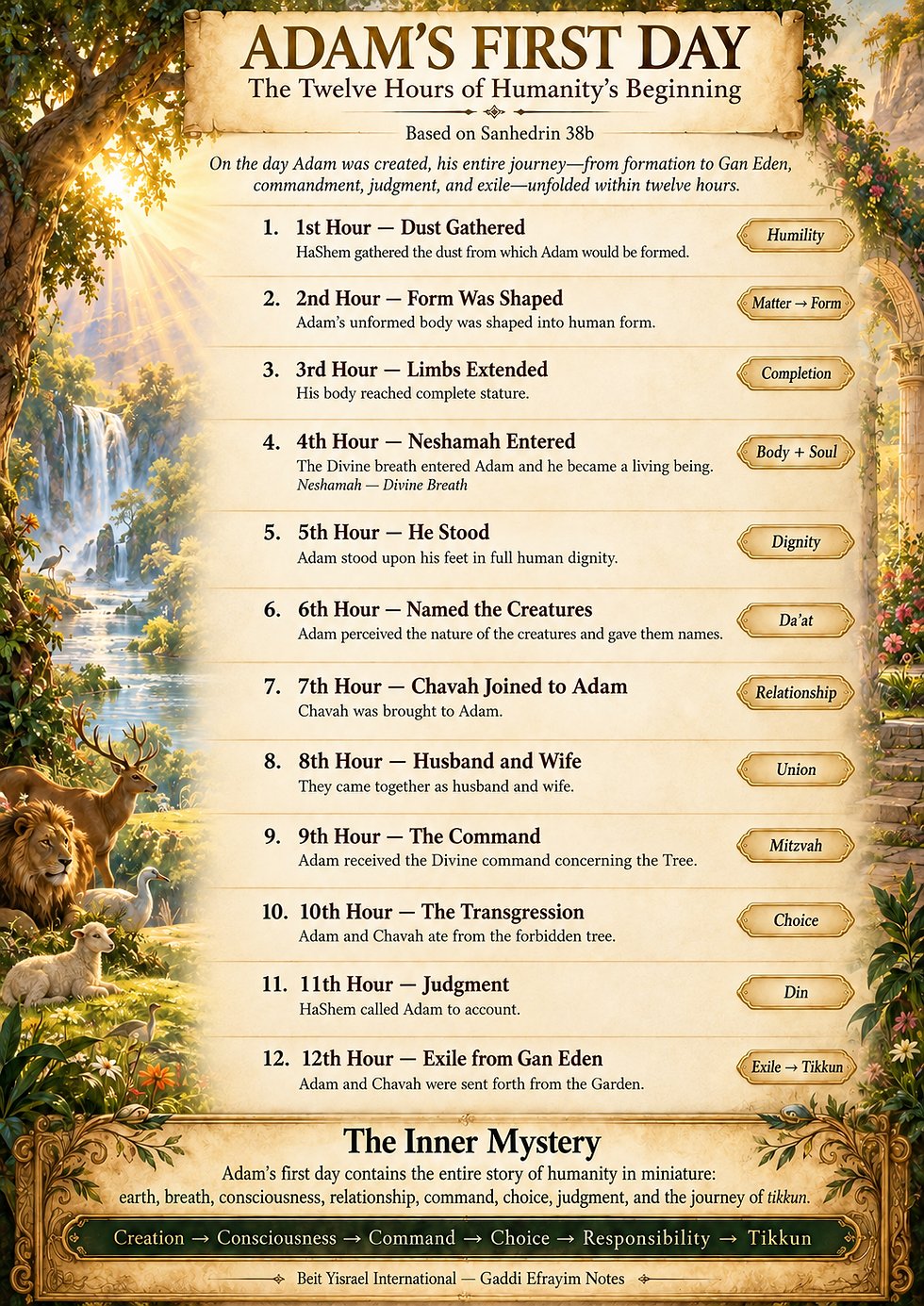
At the root of this teaching stands Adam HaRishon, created in Tzelem Elokim—the Likeness of God.
The sages explain that this likeness was not merely moral or spiritual; it was functional.
Adam was endowed with the capacity to name creation:
“And whatever Adam called each living creature, that was its name (Hu Shmo)” (Genesis 2:19).
1. Naming as Redemption — Hu Shmo = Mashiach
The act of naming is an act of inner revelation. In Hebrew thought, a name (shem) reveals the soul-root of a thing.
When Adam named the creatures, he was not labeling them—he was uncovering their divine spark and aligning them with their purpose.
The sages point out a striking equivalence: הוא שמו (Hu Shmo) = משיח (Mashiach) = 358
This teaches that Mashiach is embedded within naming itself. Everything that exists contains a spark of the soul of Mashiach, waiting to be redeemed and returned to the service of the Living God.
Gaddi Efrayim Note:
Mashiach is not only a person to be revealed at the end of days; he is the hidden soul-force within creation that calls each thing back to its true Name.
2. The Temple — Elevating All Levels of Creation
This principle finds its concrete expression in the Temple service. Animals, plants, and minerals—representing the four levels of creation (domem, tzomeach, chai, medaber)—were brought as offerings.
Through this avodah, humanity elevated all existence back to God.
The altar was not about destruction, but transformation. Matter itself was refined and restored to its original intention.
Beit Yisrael International Insight:
The Temple is the place where the world remembers why it was created.
This is why Mashiach is inseparable from the Temple: redemption is not escape from the physical world, but its sanctification.
3. The Messianic Era — Refining Below to Resemble Above
Chassidut teaches that the Messianic era is defined by a radical refinement of the physical:
“The physical commandments, as they are clothed in physical matter, are signs… for the physical commands are shadows of their inner spiritual essence” (Torah Ohr, Miketz 37b).
And further:
“In the days of Mashiach, we will experience a new level of obedience to the commandments, as before the sin of Adam” (Hemshekh v’Kakh 5637).
This means that mitzvot will no longer feel external or imposed; they will flow naturally from an inner alignment, just as Adam served God before the fall.
Gaddi Efrayim Note:
The future obedience is not stricter—it is truer.
4. Betzalel — The Messianic Craftsman
This Messianic dynamic is already embodied in Betzalel.
Betzalel did not merely build sacred objects—he reconstructed Creation in miniature. Empowered with Wisdom, Understanding, and Knowledge (Chabad), he fashioned the Mishkan as a restored world, mirroring Eden before the fracture.
The gematria reveals a deeper layer:
Betzalel ben Uri = 422
Adding the number of words (3) = 425
425 = Mashiach Nagid (“Prince / Ruler Messiah”) (cf. Book of Daniel 9:25)
This does not mean Betzalel was Mashiach, but that he functioned in a Messianic role—revealing how redemption operates through human partnership with God.
5. The Inner Secret
Adam named.
Betzalel built.
Mashiach completes.
All three act through the same principle: revealing the divine name hidden within reality.
Beit Yisrael International Insight:
Redemption is not waiting for heaven to descend—it is learning how to lift earth upward.
When the lower world is refined to resemble the higher, the Divine Presence dwells openly among us. This is the meaning of the Messianic era:
“The world will be filled with the knowledge of HaShem, as the waters cover the sea.”
Not a new world—but this world, finally called by its true Name.



Baruch HASHEM... Ha Qadosh Baruch HU..
The Messianic Era — Refining Below to Resemble Above
Shalom Yisrael...